Monthly Archives: January 2018

Allahabad University scientists find ‘fisetin’ slows down brain aging

The results of the AU study conclude that fisetin can protect the brain from damage induced by aging. (HT)

A team of scientists at the Allahabad University has established that a natural compound called fisetin, found in strawberry, apple, onion and cucumber, can restore brain functions which deteriorate during aging.

A team of scientists at the Allahabad University has established that a natural compound called fisetin, found in strawberry, apple, onion and cucumber, can restore brain functions which deteriorate during aging.

The findings of the team, led by Prof SI Rizvi from the department of biochemistry at AU, have been published in the latest issue of American research journal Life Sciences.

Scientists acknowledge that oxidative stress is a major factor responsible for age-related changes in living organisms. Oxidative stress is the condition when the damage, due to the toxic form of oxygen molecules, exceeds the capacity of the body to repair such damage.

“It is a paradox that oxygen, which is essential for life, becomes the cause of aging,” said Prof Rizvi.

“In human body, most of the oxygen is consumed by the brain. Therefore, it is the brain that becomes more vulnerable to oxidative stress. With increase in age, brain cells degenerate leading to diseases and loss of brain function,” he said.

Through experiments, the research team analysed a host of biomarkers of aging, including pro-oxidants, antioxidants, mitochondrial function, expression of genes, and apoptosis cell death.

The results of the AU study conclude that fisetin can protect the brain from damage induced by aging.

“The study was carried out on rats of different ages and also on those which were chemically induced to age faster,” said Prof Rizvi.

Fisetin was given to rats of old age and the effect was compared with the younger ones. Fisetin-treated old rats were protected from brain damage.

Among all anti-aging strategies being explored, caloric restriction is the most promising which, in common terms, can be defined as less food intake.

Caloric restriction has been effectively tested in small organisms like fruit fly and earthworms. The strategy becomes difficult to implement in humans where several ethical issues are involved.

Scientists have stumbled upon a class of compounds which mimic the effect of caloric restriction. With the use of these compounds, known as caloric restriction mimetics, the body feels like it is food restricted without the need of eating less.

According to Prof Rizvi, fisetin works as a caloric restriction mimetic in showing its anti-aging effect on rats. “Scientists are hopeful that compounds exhibiting caloric restriction mimetic effects will prove to be good anti-aging drugs,” he said.

Several experimental drugs are being tested in Prof Rizvi’s lab for possible anti-aging effects. “Although an increase in human lifespan may not be possible, it may increase the health span,” Prof Rizvi added.

source: http://www.hindustantimes.com / Hindustan Times / Home> Cities> Lucknow / by K. Sandeep Kumar , Hindustan Times, Allahabad / January 08th, 2018

Varanasi: Central Institute of Tibetan Higher Studies all set to welcome Dalai Lama

Varanasi :

The Central Institute of Tibetan Higher Studies (CIHTS), Sarnath is all set to give a grand welcome to Tibetan spiritual leader His Holiness the 14th Dalai Lama Tenzin Gyatso, who is arriving on Friday.

Talking to reporters on Thursday, the CIHTS vice-chancellor Prof. Geshe Ngawang Samten said that the Dalai Lama is arriving here to take part in the golden jubilee of the institute on January 1, 2018. “It is a matter of great happiness for us that we will celebrate the golden jubilee in presence of His Holiness,” he said adding that the Dalai Lama is arriving here after a gap of four year. Earlier, he had visited the institution in January 2013.

According to him, before the golden jubilee celebration the Dalai Lama will also take part in the two-day international conference on ‘concept of mind in science and philosophy’ on December 30 and 31. Eminent scholars from various universities and institutions of the country and abroad will take part in the conference to express their views. About 150 Indian delegates and over 70 foreign delegates from different countries will attend the conference. After four-day stay at the CITHS the Dalai Lama will leave for Bodh Gaya on January 2, 2018.

Established in 1967 the CIHTS is celebrating its golden jubilee in presence of the Dalai Lama, who is instrumental in establishing this institution. After the mass exodus of the Tibetan emigrants in 1959 they took political asylum in India. It was the joint efforts of the Dalai Lama and India’s first Prime Minister Jawaharlal Nehru that the CIHTS came into existence in Varanasi in 1967 to educate the youth of Tibet and the students on the Indian border who had lost the opportunity of living in Tibet for advanced studies and religious discourses in Buddhism. The institution was established with objectives like preservation of Tibetan culture and traditions, restoration of ancient learning and implementation of multi-dimensional Tibetan studies, and revival of traditional education under modern university system.

The Dalai Lama has been visiting CIHTS quite. In the beginning it was established in the premises of the Sanskrit University and later it moved to its own premises in Sarnath and was granted autonomy under the department of culture. In 1988, the institute got status of `deemed to be a university’ with financial support from the Union ministry of human resource development.

Meanwhile, the students and staff of CITHS were busy in giving final touch to the preparations. The entire campus was being decorated with flowers and floral patterns on the roads. Buddhist monks and followers from different places also started tronging Sarnath in large numbers. They will greet the Dalai Lama on his arrival on Friday.

source: http://www.timesofindia.indiatimes.com / The Times of India / News> City News> Varanasi News / by Binay Singh / TNN / December 28th, 2017

What an idea! They recycle waste flowers picked from temples and make incense sticks

Help Us Green has brought respectability to more than 200 informal “scavengers”-usually women from lower castes.

As one approaches Bhaunti, a small village 25 km west of the district headquarters of Kanpur, the smell of flowers becomes overpowering. It’s coming out of a building that houses Help Us Green, a company that collects as much as 800 kilograms of waste flowers every day from the 29 temples in Kanpur, recycles them and turns them into incense sticks and organic vermicompost (made from a composting process using various species of worms). The founders, Ankit Agarwal and Karan Rastogi, have successfully trademarked the term “Flowercycle” for this process.

The duo was visiting the temples on the banks of the Ganga in Bithoor, Kanpur, in 2015, when they thought of the idea of recycling floral waste. “Pollution caused by flowers, unlike industrial waste, is often overlooked in the drive to clean the holy river,” says Agarwal. And it’s not just the flowers rotting in the river but also the pesticides used on them, which can affect marine life. Shortly after, the two left their jobs to launch Help Us Green. “When we started, everyone thought we were mad,” says Rastogi. They started with an initial investment of Rs 72,000, and two months later, came out with their first product, a vermicompost they chose to call “Mitti”. The vermicompost has a mix of 17 natural ingredients, including coffee grounds discarded by the local outposts of a coffee chain.

Later, IIT Kanpur chipped in with some funds. Later, their company also started making environment-friendly incense sticks, sans coal, in Sarsol village in Kanpur. And since devotees found it difficult to throw packets of incense products embossed with images of gods in dustbins and so threw them in the river, Help Us Green started selling its products in paper infused with Tulsi seeds that could be sowed once the incense was used. In August this year, the duo floated another company, Kanpur Flower Cycle, with a new 20,000 sq. ft factory in Bhaunti. Another new product is in the pipeline: florafoam to replace thermocol. Help Us Green has brought respectability to more than 200 informal “scavengers”-usually women from lower castes. Earning a measly Rs 10 a day earlier, now they earn at least Rs 200.

source: http://www.indiatoday.intoday.in / India Today / Home> News> Magazine> Cover Story / by Ashish Misra / January 05th, 2018

With ancient flora, UP plans to revive Govardhan Parvat

Govardhan Parvat as it is today.

HIGHLIGHTS

Yogi government is planning to promote UP’s religious sites for tourism in a big way.

He had formed the Brij Tirath Vikas Parishad just two months after Rampur assuming office.

Lucknow :

The UP government is planning to rejuvenate the almostbarren Govardhan Parvat, which has huge mythological significance for Hindus, by reviving flora of Dwapar Yug along its 21-km perambulation path. Indian Agriculture Research Institute has been roped in for the project in Mathura.

The Yogi Aditya Nath government is planning to promote the state’s religious sites for tourism in a big way. Yogi had formed the Brij Tirath Vikas Parishad just two months after Rampur assuming office.

The CM, who is also the chairman of the parishad, has tasked it to find five varieties of trees: kadamb, karoli, tamal, pakkad and tilkan and develop the vegetation around Govardhan Parvat to resemble what has been described in the sacred texts.

Myhtology has it that Lord Krishna picked up Govardhan hill, and held it above his head with his little finger for seven days to protect villagers from incessant rain, a result of the wrath of Indra.

“In Hindu mythology, kadamb was the favourite tree of Lord Krishna, who used to play the flute and play with his friends under its shade. We’ve sent our research team to find this tree in Rajasthan’s Karoli Dham area. The entire Govardhan project is being monitored by the CM,” said Brij Tirath Vikas Parishad CEO Nagendra Pratap.

In a recent report to the CM, the parishad said the hill’s green cover had shrunk over the years and it was necessary to preserve its sanctity as it was intrinsic to Hindu culture and mythology.

The government has sanctioned Rs 226 crore as the first instalment for the project. Forest officials blame brackish water of the Yamuna in Mathura for poor vegetation on the hill. The parishad now plans to use water harvested from neighbouring Bharatpur district in Rajasthan for irrigation around Govardhan Parvat, said Pratap.

source: http://www.timesofindia.indiatimes.com / The Times of India / News> City News> Lucknow News / by Rohan Dua, TNN / January 04th, 2018

2018: Lucknow set to sizzle on the silver screen

2017 turned out to be a golden year for films shot in Lucknow and other Uttar Pradesh districts. In fact, the state bagged the “Best Film Friendly State” award at the prestigious 64th National Film Awards.

Movies like Bareilly Ki Barfi, Babumoshai Bandookbaaz and Shaadi Mein Zaroor Ana shot here ruled the box office while others like Lucknow Central got good reviews.

The year also saw some big banner films being shot here which will be released in 2018. These includes films shot by veterans like ‘No One Killed Jessica’-fame Raj Kumar Gupta, Anurag Kashyap, Ra.One fame Anubhav Sinha and 100 Days-fame Partho Ghosh.

HT City takes a look at the films that will hit screen this year:

Mukkabaaz

Anurag Kashyap’s next is the first film shot in Uttar Pradesh that will be released in 2018 on January 12. Starring Vineet Kumar Singh with Zoya Afroz, Jimmy Shergill and Ravi Kishan, the film is a story of a boxer. The love story is weaved around the sports drama which also brings out politics in sports and other barriers. Vineet transformed himself as a boxer after an intense training in Palitya.


Raid

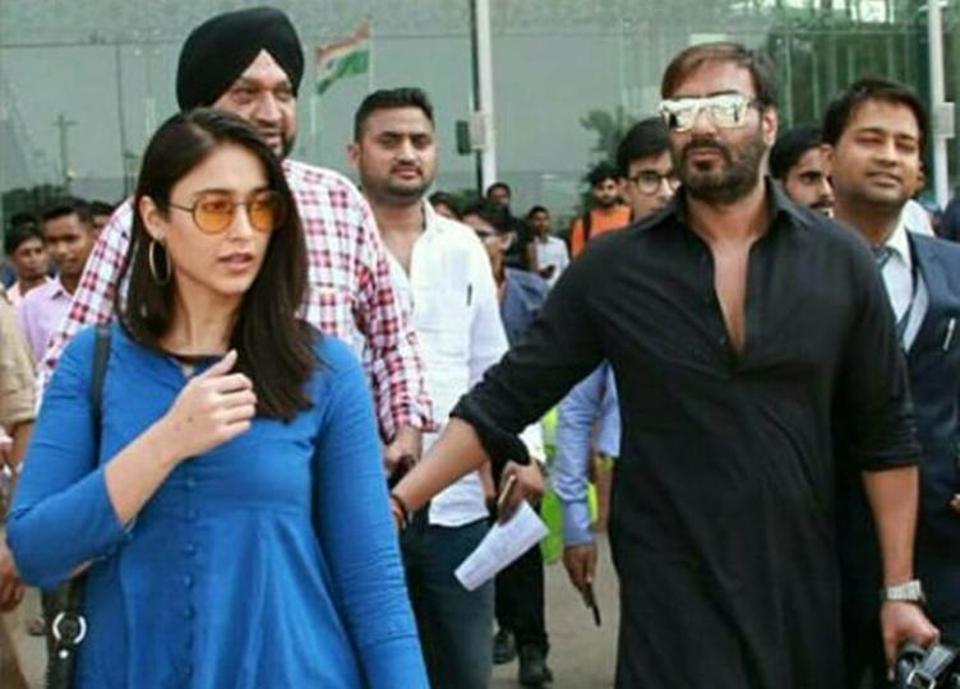
Stretched over two months Ajay Devgn and Illena D’Cruz shot Raid in the state capital a thriller which is based on raids that happened in 1980s. Produced by Kumar Mangat and directed by Raj Kumar Gupta, the film is set to hit screens in the first part of 2018. “Raid too is inspired by real incidents that took place in 1980s but are relevant even today,” Gupta told HT.

DaasDev

Sudhir Mishra’s DaasDev that was shot around two years back will finally hit screens on February 16. A spin-off of Devdas, the ensemble cast features Rahul Bhatt, Richa Chadda, Aditi Rao Hydari, Vineet Kumar Singh and Saurabh Shukla. The director dubs it as a reverse journey of Dass to Dev with lot of politics mingled in the love story making it very contemporary.


Mulk

Ra.One director shot his first film in the home state with Rishi Kapoor, Taapsee Pannu and Prateek Babbar. After making love stories, glossy and larger than life films he shot his first “realistic” since he started making films, confessed the director. He is ready with more projects. “I have a script ready which I was to shoot first but I will probably shoot next. It will be shot in a smaller place probably in a tehsil. I also have another film that again can be shot in Lucknow,” he said.

Vinod Bachchan’s next

The Tanu Weds Manu producer delivered another hit with Raj Kumar Rao-starrer Shaadi

Mein Zaroor Ana. Directed by Ratna Sinha, the film besides earning well was recently screened at Rashtrapati Bhawan. Bachchan is now working out to make another installment of the film. “We are working on the script and it will be either a sequel or its prequel. But, before that, we are coming to Lucknow to shoot two more films. Bin Phere Hum Tere and Yaaro Ki Baraat are two scripts that we will make making here this year. The cast is being worked out and we hope to start Bin Phere…first. It’s also a small town story from the Hindi heartland,” he tells HT City.

Ban in Pakistan

If we go by its name, the movie has already been banned in Pakistan! Titled Yeh Picture Pakistan Mein Ban Hai, the film was shot in Lucknow and is being made by Sunil Subramaniam. Starring Filmistan-fame Sharib Hashmi, Aditi Sharma, Chunkey Pandey, Upasana Singh, Mukesh Tiwari, Inaamulhaq, Nand Pakistani comedian Rauf Lala, the film was shot extensively in Lucknow for nearly 40 days. The film shot in 2016 is expected to hit screens soon.

Small films lined-up

“Besides big releases, the years will see films that have been shot in 2016 also hit screens. It is good that pending films will be realised like DaasDev and Yeh Picture Pakistan Mein Ban Hai. The message in Mumbai is positive and films are coming to the state. We hope the good run continues,” tells line producer Aroon Singh Dicky.

The movies that will also release soon are Aarzi starring Zeeshan Ayyub and Shama Sikandar. Then there is Tilli directed by Sagar Sharma with Raghuvir Yadav and Atul Srivastava. Lupt directed by Prabhu Raj with Karan Anand, Meenakshi Dixit, Vijay Raaz, Javed Jafri, Nikki Walia will also be shot soon.

Sharman’s two films

The shooting of the film Babloo Bachelor, directed by Agnidev Chatterjee was held at a house in Naka Hindola with actors Sharman Joshi, Aakash Dabhade and Puneet Vasishtha. The film’s story revolves around Babloo who’s looking for a suitable bride. The film also stars Pooja Chopra and Tejashree Pradhan. Earlier in 2017 he’s shot for the film Kashi in Varanasi. 3 Idiot famed actor plays character named Kaashi who is in search of his sister Ganga in the suspense thriller. Debutant Aishwarya Devan plays the female lead. The film has Govind Namdev, Akhilendra Mishra, Manoj Joshi, Manoj Pawha and Priyanka. The film is being directed by Dheeraj Kumar.

source: http://www.hindustantimes.com / Hindustan Times / Home> Cities> Lucknow / by Deep Saxena & S. Farah Rizvi, Hindustan Times, Lucknow / January 02nd, 2018

Entrepreneurs on the fast track

A mobile app and new-age rail ticketing

Anand Purohit earns IRs. 50,000 a month as a ticketing agent using the RailYatri app

Twenty-six-year-old Anand Purohit is not looking for a job any more. He says he has found a profitable vocation. This resident of the tiny town of Akot, in Maharashtra, was not keen on joining his father’s kirana shop and hotel business. “I wanted to break out on my own, earn for myself and do something different.”

Gunjeeta Tiwari Bhatt runs her business from home and can care for her baby too

Ditto the case with 31-year-old Gunjeeta Tiwari Bhatt, who had been working as an accountant for five years in Uttarakhand. When she married and moved to Delhi, she wanted to look after her child and also try her hand at entrepreneurship. “I manage to look after my one-year-old and run my independent business from home,” she says gleefully.

Both Purohit and Bhatt are part of a new breed of entrepreneurs created this year, thanks to the travel app RailYatrti. As ticketing agents for the app, authorised by the Railways, they earn ₹40,000-50,000 a month.

On any given day, the RailYatri mobile app has around 300 or so ticketing agents answering customers’ queries, helping them book tickets, confirm and re-book their journeys, and assisting with refunds on the massive Indian Railways network across the country.

All in one place

A third-party mobile app, RailYatri provides every kind of railway-related information, including train cancellations, route change, delayed start, important hotspots such as railway accident sites, visibility during fog and congestion on routes. But for services like ticket booking or queries on refunds, passengers are routed to the ticket agents via the app.

So, how does the app work? From the app installed on your mobile phone, you are routed to a ticket agent, who answers queries and handles the online booking. For those who find reservations tedious and complicated, the app is a convenient solution. It’s almost like how you book a cab on Uber or Ola. The difference here is that you have a human interface handling your travel requirements. Payments can be through money wallets, net banking, and debit and credit cards.

Besides handling all enquiries regarding train routes, distances, fares and refunds, the ticketing agent also suggests the best options for confirmed reservations. “We simplify train travel as much as possible,” says 42-year-old Deepak Suri from Bareilly. Known to be one of the most successful RailYatri entrepreneurs, he says he was about to close down his railway reservation agency when the mobile app appeared two years ago.

Today, he has eight employees to handle calls routed through the RailYatri app. With 100-200 phone calls for ticket bookings a day, he makes a monthly sale of ₹70-80 lakh. “Above all, the technology ensures that I get timely payment for my sales — no more do I have to work on credit.”

DEEPAK SURI, RailYatri agent in Bareilly

Sitting in Bareilly, Suri serves customers all over the country. “Requests come from Kolkata, Gorakhpur, Benares, Puri, Mumbai, Nashik — you name it.” The rail reservation business he set up 10 years ago had substantial traffic until it took a massive hit with the advent of cybercafés and online booking. Now he is back in profit with RailYatri.

Customer queries

And what is the most asked question by passengers? Purohit, who has employed two people this year, says ticket confirmations seem to be their main worry. “Through the app, which uses machine learning, I am able to give them the best solution.” RailYatri uses predictive analytics to zero in on wait-listed and quota-specific tickets with the best chance of confirmation.

“Refunds is another area where customers need help,” says Bhatt, who initially trained for a few days at the RailYatri headquarters in Noida.

RailYatri was started two years ago when technology buffs got together “to remove the black box that shrouds information regarding Indian Railways”. Today, the app has grown to include food and gift delivery at stations. And with its user base growing, the field is opening up for more Purohits and Bhatts to become part of the journey.

source: http://www.thehindubusinessline.com / Business Line / Home> India Interior / by Preeti Mehra / December 29th, 2017

200th Christmas for Faizabad church

A German music band celebrates Christmas with children

Faizabad

Built 200 years ago, Wesleyan Chapel, a fine specimen of British Architecture, for the British soldiers posted in Faizabad Cantonment, Church of North India is all decked up to celebrate Christmas.

Wesleyan Chapel, built in 1816, merged with Diocese of Lucknow in 1970 and then came to be known as Church of North India.

Talking to TOI, Rev Kaushalendra Solomon, pastor of the church said that special prayer service would be held at midnight on Christmas and then in the morning. Different religious activities will continue in the church till December 31and a special watch night service would be held on New Year eve.

The church committee led by secretary Chitij Charles has ensured special decoration with flowers and lighting as the Church has completed 200 years. Rev Solomon said that they get special cakes baked for Christmas celebrations at a local bakery.

“Ghulam Mohammad, a local scholar, said that Maulvi Ahmad Ullah Shah, who was leading the 1857 mutiny against Britishers from Faizabad, had instructed his soldiers not to damage the Wesleyan Chapel because it was a place of worship.”

source: http://www.timesofindia.indiatimes.com / The Times of India / Home> Neww> City News> Lucknow News / by Arshad Afzal Khan / TNN / December 25th, 2017

National film awards:The feeling is yet to sink in, says Yatindra

Lata: Sur Gatha is based on interviews with the legendary singer that took eight years to shape up.

Yatindra Mishra(HT Photo)

Yatindra Mishra, author of Lata: Sur Gatha, became the first UPite to win the Swarna Kamal award at the 64th National Film Awards that were announced on Friday.

After 12 years a Hindi work has won the Best Book on cinema category in the prestigious award. In 2005, Doordarshan’s ex-chairman Sharad Dutt from Delhi had won the award for his biography on KL Sehgal in Hindi.

Speaking to HT City from Ayodhya, Mishra said, “I still don’t believe that I have won the National Award for my book. It was only after I read it on official website and wishes started pouring in that I believed it to be true. Honestly, it is yet to sink in. It’s not just my feat but a glory for the state too.” The book gives an insight on melody queen Lata Mangeshkar’s life, her seven-decade career and its impact on Indian cinema.

The book has been selected out of 33 official entries in various languages. “Mostly books in Bengali, Marathi and other languages have bagged this award in previous years. The award carries a Swarna Kamal citation and Rs 75,000 each to the author and publisher – Vani Publication. The book, that was release in October last year, has already won three awards,” he said.

Lata Mangeshkar (HT File Photo)

Lata: Sur Gatha is based on interviews with the legendary singer that took eight years to shape up. “One year I just did the research while the interviews were spread across six years and then it took a year to pen the book,” he said.

In 2000, he wrote his first book ‘Girija’ on legendary classical singer Girija Devi followed by a book on shehnai maestro Ustad Bismillaha Khan, which is also a part of NCERT syllabus and is taught in schools. He has authored four poetry books and wrote a book on ‘Devpriya’ on dancer Sonal Man Singh.

“On cinema, I have written a musical history ‘Humsafar’ that came out during the celebrations of 100 years of cinema (2013). I also compiled Gulzar saheb’s poetry ‘Yar Julahe’ while another book is ‘Milon Se Din’ — a compilation of songs,” he tells. Mishra is now looking forward to speak to melody queen very soon. “Today I recall a line said by Lataji when I asked her about being conferred the highest civilian award Bharat Ratna. She said, ‘…shayad aapki apni bhakti aur vishwas bhi unmein sahayak hotey hai.’ (…probably your own devotion and faith helps in it).” He will be given the award by President Pranab Mukherjee on May 3.

source: http://www.hindustantimes.com / Hindustan Times / Home> Cities> Lucknow / by Deep Saxena,Lucknow, Hindustan Times / April 12th, 2017