Category Archives: Business & Economy

Time to ‘Spring up’ Lucknow as Spring House Coworking Launches Its New Space in the City

A community enabler with a more collaborative, innovative and state-of-the-art environment

One of India’s most diverse community enablers, Spring House has opened doors to its newest co-working space in the ‘City of Nawabs’ in collaboration with Design Factory India. This is Spring House’s second successful association with this premier experience design firm, the first being in Noida.

This coworking space is located in Gomti Nagar and comprises of 50 workstations. It offers amenities like high-speed internet, courier and printing services, housekeeping services, complimentary tea & coffee and access to conference rooms.

Sourabh Gupta, Founder of Design Factory India shares, “We are delighted to partner again with Spring House, one of India’s fastest growing network of co-working spaces. Spring House, Lucknow; is designed to complement the modern work force and portrays fine balance of well-designed layouts and essential features which will help Lucknowites manage their work with ease.”

As an integral part of their strategy to provide flexibility and choice around how people work, Spring House has expanded beyond NCR and entered a tier-2 city. Be it start-ups, SMEs, online professionals, freelancers or teams of large corporate houses; everyone can experience this preeminent one-stop ecosystem of the most connected professionals across various industries. After enabling communities across 9 locations with co-working spaces and business centres across Delhi, Gurgaon and Noida, Spring House is ready to launch in Lucknow. Their vision is to bridge the gap between entrepreneurs from Lucknow and the well-established startup ecosystem across Delhi NCR.

Speaking about the launch of the new workspace, Mukul Pasricha, Founder & CEO, Spring House said, “We are extremely dedicated to endorsing local growth. Once we started getting positive appreciation from tier-2 cities, it was indeed quintessential to make the move. We are currently one of the first few established co-working spaces that has opened in Lucknow with a fully managed centre. Lucknow has a large youth population and a community enabler like Spring House can motivate them to turn dreams into start-ups. We firmly believe that a tier-2 city is always just one startup away from putting them on the world map.”

source: http://www.bwdisrupt.businessworld.in / BW Disrupt / Home / by BW Online Bureau / March 14th, 2018

Brigadier Kapil Mohan didn’t just build Old Monk brand, he was true architect of Indian liquor industry

It was not an in-your-face impression that one got when entering the sprawling office of the chairman and managing director of Mohan Meakin Ltd at Mohan Nagar in Ghaziabad, on the outskirts of Delhi. The ambience was simple, somber, friendly even — with none of the frills of modern-day corporate offices. Brigadier (retd.) Kapil Mohan, sat in this office for more than four decades, and presided over one of the oldest liquor companies of our country.

My last meeting with the grand old man of the Indian liquor was a couple of years ago. As usual, the patriarch of Mohan Meakin was sitting in his unassuming office — lined with trophies, shields and certificates — and surrounded by about half a dozen people. He was regaling them with interesting anecdotes. He was a known treasure trove of such stories, featuring politicians, bureaucrats and colleagues of all hues.

During one such favourite storytelling trip, I suggested (rather, asked) he write these down as first-person accounts — where all such stories could find a place; he laughed it off, saying that would rub several people the wrong way.

Man behind Old Monk rum, Brigadier (retd.) Kapil Mohan dies of cardiac arrest at 88; was awarded Padma Shri in 2010

Even for his own team, he was never the stiff corporate boss. Senior personnel who have worked closely with Brig. Mohan said his most significant strategy and strength was that he involved the entire labour team for any discussions about company-related issues, and paid due heed to their suggestions. Intensely philanthropic and empathetic, he always showed keen interest in the welfare of labourers — at times even more so than that of his executives. Through his brilliant man-to-man personal skills, he created an environment of friendship for the labourers, and went the extra mile to encourage his staff to do the same.

Brigadier (retd.) Kapil Mohan, and the iconic squat bottle of Old Monk rum. File Photo

This was possibly the biggest reason why Mohan Meakin remained — till the 1990s — the only company in India that never had a labour strike.

The current COO of Khoday India Limited Satpal Chaudhry too had been on receiving end of Brigadier Mohan’s large-heartedness. Chaudhry worked with Brig Kapil Mohan for 19 years before moving on to bigger things. “I joined Mohan Meakin in 1971. I wanted to improve my qualifications, and in 1974 appeared for an entrance test for IIT Delhi for MTech. I approached the brigadier to allow me to do the course; he didn’t even bat an eyelid and gave me permission, that too on full-term basis.”

Chaudhry was emotional while remembering the brigadier. According to Chaudhry, Brig. Mohan was a great visionary who always looked for excellent brands, and better quality for liquor products and beer. “The brigadier went on to modernise the distilleries and breweries, while we could not even meet the demand for liquor, which exceeded that of our supply. At that point, Mohan Meakin was the only liquor producer in India which had such a large number of popular brands,” Chaudhry said.

Brig. Kapil Mohan also had an eye for spotting talent. Chaudhry was among those headhunted by the brigadier. He recollected the time while he employed with Mohan Meakin and received a call from the boss; Chaudhry was asked by Brig. Mohan to come in for a promotion.

“I was working in Lucknow for about seven years, looking after the distillery, brewery and soft-drink plant. One day I got a call from Brig. Mohan to join as ‘Works Manager’ of the company in Mohan Nagar. This was a dream job for anybody: it was a designation next to the managing director himself. Brig. Mohan did not even bother with the senior people who were quite close to the management, but offered me to opportunity to run the operations of the brewery, distillery, malting plant and juice factory. He also made me the engineering chief of Mohan Meakin, which was a personal milestone,” Chaudhry said.

There are many who will remain forever indebted to this man with a golden heart. Not many know that it was under Brig Kapil Mohan’s stewardship that the group was rechristened Mohan Meakin Limited. Brig. Kapil Mohan was the person who modernised the plants and machinery, and brought in new technology and undertook major diversification of three distilleries in India, two breweries and a host of franchises.

Although the iconic Old Monk rum was launched by his father, Narendra Nath Mohan, in 1954 and brought to prominence by his brother Colonel VR Mohan, it was Brig. Kapil Mohan who made it into the instantly recognised and largest-selling rum in India.

Before Indian single malts came into the picture, Old Monk was the one of the most recognised brand available in all foreign liquor stores and airport duty shops across the world. Till 2012, Old Monk was undisputedly the No.1 rum brand, but began to slide in volume, and lost its top position to other brands such as McDowell’s Celebration Rum by USL.

However, the slide has not dimmed the charm of “Boodha Padri” (Old Monk transliterated into Hindi, and fondly called so by its fans) and the iconic squat bottle it comes in.

“I don’t think there is any other person in the liquor industry that can match Brig. Mohan. He was a true architect of the Indian liquor industry,” says Chaudhry.

source: http://www.firstpost.com / FirstPost / Home> Latest News> Living / Bishan Kumar / January 16th, 2018

Meerut scissors make the cut for GI tag

Barber scissors hand made in Meerut with scrap metal.

For the first time, a handmade tool from micro and small and medium enterprises in India has been registered for a geographical indicator (GI) tag, an official of a body promoting this sector said on Wednesday.

The tool is a pair of scissors made of metal scrap by a community in Meerut, which is “the only scissor cluster in India” and which has been making the product for more than three centuries, Karamjeet Singh Saluja, Deputy Director- Intellectual Property Rights, Federation of Indian Micro and Small and Medium Enterprises (FISME), IP Facilitation Centre, told reporters on the sidelines of an IPR awareness programme held here.

The programme focused on innovators, micro, small and medium enterprises and other industries. It was organised by the FISME, which promotes entrepreneurship and works to improve market access for these units. The IP Facilitation Centre, sponsored by the Development Commissioner, MSME, Union Ministry of MSME, facilitated the registering of the scissors for the GI tag. Sharif Ahmad, vice-president, Meerut Scissors Manufacturers Special Purpose Vehicle, and a seventh-generation craftsman, told The Hindu on the phone: “The GI tag will make a difference to us. No one else will be able to copy our scissors or misuse the made-in-Meerut tag our handmade scissors offer…”

The tag would enable the crafters to make scissors of standard sizes and of high quality, he said. At present, the size varies, from six inches to 14 inches, and the scissors are sold at a price ranging from Rs.20 to Rs.500.

Known for their sharpness, the scissors are used at home and by industrial garment manufacturers.

They can be repaired, unlike other scissors that are thrown out after use.

In the Uttar Pradesh Hindi, the phrase used to vouch for the quality of the scissors is Dada le, potaa barpe (a product bought by the grandfather, but which continues to be used by his grandson), Mr. Ahmad said, to underscore the scissors’ quality.

The Meerut scissors are made of carbon steel blades sourced from scrap metal found in cars, buses, trucks and railways. The handles are made of plastic, aluminium or alloys, which are sourced from old utensils. All the parts are pre-used. The first pair was made 360 years ago by Asli Akhun.

Meerut has 250 small-scale scissors-making units, employing 70,000 people directly and indirectly. Both the Central and Uttar Pradesh governments have helped the industry.

While men make scissors, women do the tasks that require handwork and pack the products.

They are sent only to the domestic markets, but the makers find it tough to meet the demand at home.

Mr. Saluja said the GI tag was given to products based on certain information submitted to the Geographical Indication Registry, Chennai: proof of origin, the GI map, the statement of case and the history of the product.

At present, the FISME, which is present in Delhi, Hyderabad and Bangalore, is working to get the GI tag for three more products.

source: http://www.thehindu.com / The Hindu / Home> Crafts / by Renuka Phadnis / Mangaluru – January 10th, 2018

Craftsmen from Bareilly, made in Jaipur

Artisans make kites at Handipura market in Walled City on Friday.

Jaipur :

Gone are the days when traders of Jaipur used to bring in truckloads of kites from Bareilly and Rampur in Uttar Pradesh for genuine kite lovers and ‘ustaads’ of the city.

In bid to make the business more economically viable, many traders have hired kite makers of Bareilly to design and produce quality ‘patang’ locally.

Labourers from famed kite manufacturers of Bareilly and Rampur have been brought to Jaipur to make them here.

Major kite markets, including those in Handipura, Haldiyon Ka Raasta, Jhotwara, Murlipura and Kishanpole Bazaar, are full of kites made by the labourers from UP.

Most of them were brought to the city in November itself to complete the orders given by local traders as well as those from districts such as Sikar, Jhunjhunu and Churu where there’s a huge demand, starting a fortnight prior to the auspicious occasion of Makar Sakranti.

On reasons why the local traders are not buying directly from UP, Ravi Khandelwal, a wholesale kite trader in Jhotwara, said, “From December, places, including Rampur and Bareilly, witness moderate to heavy fog. Every year, loads of kites get damaged as trucks bringing these kites come via Delhi. So, we contacted the UP producers and asked them to send their workers here to make kites for us.”

Akhtar Hussain, a wholesale kite trader at Handipura, said that the state has a big market for kites as they were flown almost around the year on various occasions. “In places like Alwar, Ajmer and Dausa, people fly kites during Raksha Bandhan. In Jaipur, Sikar, Jhunjhunu, Churu and Bikaner, they are flown on the occasion of Makar Sakranti.

And many other districts fly them on August 15 like in Delhi. So, the traders here have engaged craftsman from UP,” Hussain added.

However, some local traders try cheat by selling ‘fake’ UP kites. “Some stick rubber stamps of kite manufactures of Bareilly. So, kites which are actually made by local craftsmen are stamped as manufactured in Bareilly,” said Suraj Saini, a wholesale dealer at Haldiyon Ka Raasta.

But traders said that genuine kite lovers can differentiate between both. “UP ki patang ka bans thoda kala seeka hua hota hai (The bamboo used in UP kites has been treated using fire),” said Anil Pandey, a kite lover.

The most popular Kites from UP includes ‘adhha’, ‘pauna’, ‘aadha’, ‘dedh kanni’ and ‘danda’.

source: http://www.timesofindia.indiatimes.com / The Times of India / News> City News> Jaipur News / by Ashish Mehta / TNN / January 13th, 2018

IIT-K develops gadgets for specially abled

Kanpur :

IIT-K’s persons with disabilities (PwD) cell organised an event on Tuesday for people with disabilities and the challenges they have overcome.

PwD cell convenor KS Venkatesh said that the cell is developing tools and services to help students with disability on campus. These include developing special gadgets and making all areas of the campus accessible to them.

A special website dedicated to the PwD cell was also launched. The website will act as an important resources for people with disabilities on campus.Visit www.iitk.ac.in/pwd for more information.

Several organisations working with people with disabilities were invited to deliver talks. These include handicap welfare department, Uttar Pradesh, Deaf and Dumb College, Bithoor, Ambedkar Institute of Technology for Handicapped, Kanpur and others.

source: http://www.timesofindia.indiatimes.com / The Times of India / Home> City News> Kanpur News / TNN / January 10th, 2018

Japanese envoy in city, takes stock of VCC project

Japanese ambassador Kenji Hiramatsu visited the VCC construction site at Varanasi Municipal Corporation

Varanasi :

Japanese ambassador to India Kenji Hiramatsu visited Varanasi Municipal Corporation on Thursday afternoon to take stock of the progress in work of Varanasi International Cooperation and Convention Centre (VCC).

The Japan International Cooperation Agency (JICA) is bringing this VCC with an investment of Rs 130 crores by removing VMCs Sadan, mayor office and Tilak Prekshagrih (auditorium). As per the protocol of Hiramatsu received by the district administration, his meeting with mayor Mridula Jaiswal was proposed with site inspection of VCC between 11.30 am and 12.30 pm.

However, his flight was delayed due to which his meeting with the mayor was cancelled but he visited VMC to take stock of progress in work of VCC. On debris of the demolished portion of VMC Sadan, mayor office and Tilak auditorium he questioned the VMC and JICA officials whether the area would be given for construction after removing debris in response of which the officials informed him the timeframe for removal of debris. After this he left for Banaras Hindu University.

On September 15, an agreement was signed with the government of India to provide grant aid of up to 2,240 million yen (approximately Rs 130 crores) for the project for construction of VCC. The VCC will be one of the prime examples of state-of-the-art facility nurturing the cultural and social exchanges. VCC will be a sophisticated convention centre comprising of a main hall with a full flying tower, having a capacity of 1,200, a gallery, meeting rooms, together with a parking facility of 120 cars.

The Japanese ambassador reached BHU to deliver a special lecture on ‘experience and contribution to India in environmental field’ organised by the institute of environment and sustainable development.

source: http://www.timesofindia.indiatimes.com / The Times of India / News> City News> Varanasi News / TNN / Decembr 22nd, 2017

What an idea! They recycle waste flowers picked from temples and make incense sticks

Help Us Green has brought respectability to more than 200 informal “scavengers”-usually women from lower castes.

As one approaches Bhaunti, a small village 25 km west of the district headquarters of Kanpur, the smell of flowers becomes overpowering. It’s coming out of a building that houses Help Us Green, a company that collects as much as 800 kilograms of waste flowers every day from the 29 temples in Kanpur, recycles them and turns them into incense sticks and organic vermicompost (made from a composting process using various species of worms). The founders, Ankit Agarwal and Karan Rastogi, have successfully trademarked the term “Flowercycle” for this process.

The duo was visiting the temples on the banks of the Ganga in Bithoor, Kanpur, in 2015, when they thought of the idea of recycling floral waste. “Pollution caused by flowers, unlike industrial waste, is often overlooked in the drive to clean the holy river,” says Agarwal. And it’s not just the flowers rotting in the river but also the pesticides used on them, which can affect marine life. Shortly after, the two left their jobs to launch Help Us Green. “When we started, everyone thought we were mad,” says Rastogi. They started with an initial investment of Rs 72,000, and two months later, came out with their first product, a vermicompost they chose to call “Mitti”. The vermicompost has a mix of 17 natural ingredients, including coffee grounds discarded by the local outposts of a coffee chain.

Later, IIT Kanpur chipped in with some funds. Later, their company also started making environment-friendly incense sticks, sans coal, in Sarsol village in Kanpur. And since devotees found it difficult to throw packets of incense products embossed with images of gods in dustbins and so threw them in the river, Help Us Green started selling its products in paper infused with Tulsi seeds that could be sowed once the incense was used. In August this year, the duo floated another company, Kanpur Flower Cycle, with a new 20,000 sq. ft factory in Bhaunti. Another new product is in the pipeline: florafoam to replace thermocol. Help Us Green has brought respectability to more than 200 informal “scavengers”-usually women from lower castes. Earning a measly Rs 10 a day earlier, now they earn at least Rs 200.

source: http://www.indiatoday.intoday.in / India Today / Home> News> Magazine> Cover Story / by Ashish Misra / January 05th, 2018

2018: Lucknow set to sizzle on the silver screen

2017 turned out to be a golden year for films shot in Lucknow and other Uttar Pradesh districts. In fact, the state bagged the “Best Film Friendly State” award at the prestigious 64th National Film Awards.

Movies like Bareilly Ki Barfi, Babumoshai Bandookbaaz and Shaadi Mein Zaroor Ana shot here ruled the box office while others like Lucknow Central got good reviews.

The year also saw some big banner films being shot here which will be released in 2018. These includes films shot by veterans like ‘No One Killed Jessica’-fame Raj Kumar Gupta, Anurag Kashyap, Ra.One fame Anubhav Sinha and 100 Days-fame Partho Ghosh.

HT City takes a look at the films that will hit screen this year:

Mukkabaaz

Anurag Kashyap’s next is the first film shot in Uttar Pradesh that will be released in 2018 on January 12. Starring Vineet Kumar Singh with Zoya Afroz, Jimmy Shergill and Ravi Kishan, the film is a story of a boxer. The love story is weaved around the sports drama which also brings out politics in sports and other barriers. Vineet transformed himself as a boxer after an intense training in Palitya.


Raid

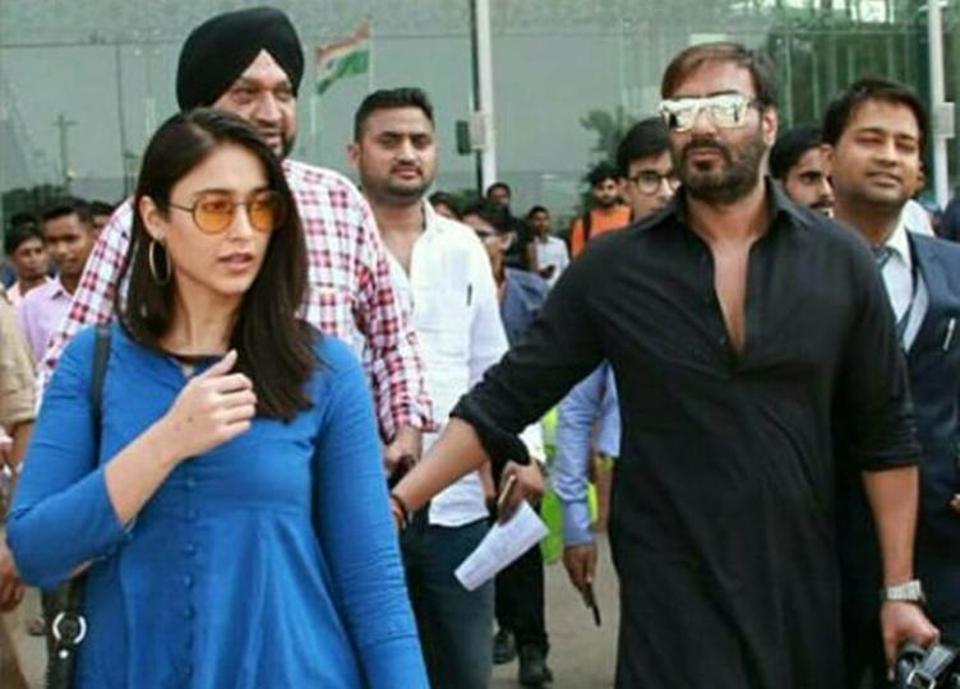
Stretched over two months Ajay Devgn and Illena D’Cruz shot Raid in the state capital a thriller which is based on raids that happened in 1980s. Produced by Kumar Mangat and directed by Raj Kumar Gupta, the film is set to hit screens in the first part of 2018. “Raid too is inspired by real incidents that took place in 1980s but are relevant even today,” Gupta told HT.

DaasDev

Sudhir Mishra’s DaasDev that was shot around two years back will finally hit screens on February 16. A spin-off of Devdas, the ensemble cast features Rahul Bhatt, Richa Chadda, Aditi Rao Hydari, Vineet Kumar Singh and Saurabh Shukla. The director dubs it as a reverse journey of Dass to Dev with lot of politics mingled in the love story making it very contemporary.


Mulk

Ra.One director shot his first film in the home state with Rishi Kapoor, Taapsee Pannu and Prateek Babbar. After making love stories, glossy and larger than life films he shot his first “realistic” since he started making films, confessed the director. He is ready with more projects. “I have a script ready which I was to shoot first but I will probably shoot next. It will be shot in a smaller place probably in a tehsil. I also have another film that again can be shot in Lucknow,” he said.

Vinod Bachchan’s next

The Tanu Weds Manu producer delivered another hit with Raj Kumar Rao-starrer Shaadi

Mein Zaroor Ana. Directed by Ratna Sinha, the film besides earning well was recently screened at Rashtrapati Bhawan. Bachchan is now working out to make another installment of the film. “We are working on the script and it will be either a sequel or its prequel. But, before that, we are coming to Lucknow to shoot two more films. Bin Phere Hum Tere and Yaaro Ki Baraat are two scripts that we will make making here this year. The cast is being worked out and we hope to start Bin Phere…first. It’s also a small town story from the Hindi heartland,” he tells HT City.

Ban in Pakistan

If we go by its name, the movie has already been banned in Pakistan! Titled Yeh Picture Pakistan Mein Ban Hai, the film was shot in Lucknow and is being made by Sunil Subramaniam. Starring Filmistan-fame Sharib Hashmi, Aditi Sharma, Chunkey Pandey, Upasana Singh, Mukesh Tiwari, Inaamulhaq, Nand Pakistani comedian Rauf Lala, the film was shot extensively in Lucknow for nearly 40 days. The film shot in 2016 is expected to hit screens soon.

Small films lined-up

“Besides big releases, the years will see films that have been shot in 2016 also hit screens. It is good that pending films will be realised like DaasDev and Yeh Picture Pakistan Mein Ban Hai. The message in Mumbai is positive and films are coming to the state. We hope the good run continues,” tells line producer Aroon Singh Dicky.

The movies that will also release soon are Aarzi starring Zeeshan Ayyub and Shama Sikandar. Then there is Tilli directed by Sagar Sharma with Raghuvir Yadav and Atul Srivastava. Lupt directed by Prabhu Raj with Karan Anand, Meenakshi Dixit, Vijay Raaz, Javed Jafri, Nikki Walia will also be shot soon.

Sharman’s two films

The shooting of the film Babloo Bachelor, directed by Agnidev Chatterjee was held at a house in Naka Hindola with actors Sharman Joshi, Aakash Dabhade and Puneet Vasishtha. The film’s story revolves around Babloo who’s looking for a suitable bride. The film also stars Pooja Chopra and Tejashree Pradhan. Earlier in 2017 he’s shot for the film Kashi in Varanasi. 3 Idiot famed actor plays character named Kaashi who is in search of his sister Ganga in the suspense thriller. Debutant Aishwarya Devan plays the female lead. The film has Govind Namdev, Akhilendra Mishra, Manoj Joshi, Manoj Pawha and Priyanka. The film is being directed by Dheeraj Kumar.

source: http://www.hindustantimes.com / Hindustan Times / Home> Cities> Lucknow / by Deep Saxena & S. Farah Rizvi, Hindustan Times, Lucknow / January 02nd, 2018

Entrepreneurs on the fast track

A mobile app and new-age rail ticketing

Anand Purohit earns IRs. 50,000 a month as a ticketing agent using the RailYatri app

Twenty-six-year-old Anand Purohit is not looking for a job any more. He says he has found a profitable vocation. This resident of the tiny town of Akot, in Maharashtra, was not keen on joining his father’s kirana shop and hotel business. “I wanted to break out on my own, earn for myself and do something different.”

Gunjeeta Tiwari Bhatt runs her business from home and can care for her baby too

Ditto the case with 31-year-old Gunjeeta Tiwari Bhatt, who had been working as an accountant for five years in Uttarakhand. When she married and moved to Delhi, she wanted to look after her child and also try her hand at entrepreneurship. “I manage to look after my one-year-old and run my independent business from home,” she says gleefully.

Both Purohit and Bhatt are part of a new breed of entrepreneurs created this year, thanks to the travel app RailYatrti. As ticketing agents for the app, authorised by the Railways, they earn ₹40,000-50,000 a month.

On any given day, the RailYatri mobile app has around 300 or so ticketing agents answering customers’ queries, helping them book tickets, confirm and re-book their journeys, and assisting with refunds on the massive Indian Railways network across the country.

All in one place

A third-party mobile app, RailYatri provides every kind of railway-related information, including train cancellations, route change, delayed start, important hotspots such as railway accident sites, visibility during fog and congestion on routes. But for services like ticket booking or queries on refunds, passengers are routed to the ticket agents via the app.

So, how does the app work? From the app installed on your mobile phone, you are routed to a ticket agent, who answers queries and handles the online booking. For those who find reservations tedious and complicated, the app is a convenient solution. It’s almost like how you book a cab on Uber or Ola. The difference here is that you have a human interface handling your travel requirements. Payments can be through money wallets, net banking, and debit and credit cards.

Besides handling all enquiries regarding train routes, distances, fares and refunds, the ticketing agent also suggests the best options for confirmed reservations. “We simplify train travel as much as possible,” says 42-year-old Deepak Suri from Bareilly. Known to be one of the most successful RailYatri entrepreneurs, he says he was about to close down his railway reservation agency when the mobile app appeared two years ago.

Today, he has eight employees to handle calls routed through the RailYatri app. With 100-200 phone calls for ticket bookings a day, he makes a monthly sale of ₹70-80 lakh. “Above all, the technology ensures that I get timely payment for my sales — no more do I have to work on credit.”

DEEPAK SURI, RailYatri agent in Bareilly

Sitting in Bareilly, Suri serves customers all over the country. “Requests come from Kolkata, Gorakhpur, Benares, Puri, Mumbai, Nashik — you name it.” The rail reservation business he set up 10 years ago had substantial traffic until it took a massive hit with the advent of cybercafés and online booking. Now he is back in profit with RailYatri.

Customer queries

And what is the most asked question by passengers? Purohit, who has employed two people this year, says ticket confirmations seem to be their main worry. “Through the app, which uses machine learning, I am able to give them the best solution.” RailYatri uses predictive analytics to zero in on wait-listed and quota-specific tickets with the best chance of confirmation.

“Refunds is another area where customers need help,” says Bhatt, who initially trained for a few days at the RailYatri headquarters in Noida.

RailYatri was started two years ago when technology buffs got together “to remove the black box that shrouds information regarding Indian Railways”. Today, the app has grown to include food and gift delivery at stations. And with its user base growing, the field is opening up for more Purohits and Bhatts to become part of the journey.

source: http://www.thehindubusinessline.com / Business Line / Home> India Interior / by Preeti Mehra / December 29th, 2017

The story of the Englishman who stayed back as a judge in India (and what it tells us about Nehru)

Having come to India in the service of an imperial power, William Broome died an Indian.

Justice William Broome is not a well-known figure today. But he lived an exciting and inspiring life.

He came to India as an imperial official, but defied British prejudices by marrying an Indian woman and devoting his life to India. He received Indian citizenship with the assistance of Prime Minister Jawaharlal Nehru and heard the early stages of Raj Narain’s challenge to Indira Gandhi’s 1971 election victory. He was unusual even among those British officials who stayed on in India after Independence. But his life still contains important lessons about what it can mean to be Indian.

William Broome was born in 1910 in London. He was appointed to the Indian Civil Service in 1932. He served in what was then the United Provinces (now Uttar Pradesh). In 1937, he married Swaroop Kumari Gour, the daughter of the lawyer, politician and academic Sir Hari Singh Gour.

This marriage was remarkable. Even though Broome served in the Indian Civil Service during a period of Indianisation, British rule in India was still characterised by racial hierarchies and segregation. The maintenance of colonial control involved the preservation of racial divides, aloofness and detachment from the Indian populace. Even India’s Anglo-Indian population was stigmatised and excluded by the English-born.

In marrying Gour, Broome defied these prejudices. He raised his children as Hindus (Broome was an atheist), learned numerous Indian languages and developed a strong interest in Indian culture.

Being Indian
Broome was appointed as a district and sessions judge in 1941. His independence in that role was legendary. When the chief secretary of the United Provinces declared that too many detainees under the Defence of India Rules were receiving bail, Broome responded by threatening the chief secretary with contempt of court.

Unlike most British judges and civil servants, Broome stayed in India as a judge after Independence. By 1958, Nehru was able to write of Broome that “I have seldom known any Englishman who has so Indianized himself in various ways as he has”, and that “he is as much as Indian as anybody can be who is not born in India and indeed probably more so than many people born in India”.

In that year, with Nehru’s assistance, Broome renounced his British citizenship and became an Indian citizen. He was appointed to the Allahabad High Court, where he served until his retirement in 1972. His judgments in this role demonstrated a strong concern for civil liberties, even going further than the Supreme Court of that time.

One of Broome’s final cases as a judge was to hear the early stages of Raj Narain’s challenge to Indira Gandhi’s 1971 election from Rae Bareli – the challenge that ultimately led to the Emergency. Broome had known Nehru and had once enjoyed a friendly relationship with Indira – he and his wife were even invited to Rajiv and Sonia Gandhi’s wedding reception. But he nonetheless made important procedural rulings in Narain’s favour. (Although Broome’s friendship with Indira Gandhi seems to have ended after this case, it is striking that no effort was made to delegitimise his decisions by referring to his foreign birth.)

Broome died in Bengaluru in 1988. Having come to India in the service of an imperial power, he died an Indian.

A noteworthy life
Broome was unusual. Although thousands of British citizens remained in India after Independence, few British officials or judges did so. Of those officials, Broome was one of the few who devoted himself to India not just as an administrator, judge or scholar but as a citizen. The fact that he embraced India until his death, and was embraced in turn, must be weighed against the departure of so many other British citizens, whether at Independence or upon their retirement, and the alienation of many Anglo-Indians from the new independent nation. His life was not necessarily representative of how other people of British descent in India felt or acted after Independence.

But Broome’s life is still noteworthy.

He was retained as a judge by the independent Indian government partially through pragmatism: despite the long struggle for independence, free India kept many of the institutions and officials that had governed (even subjugated) colonial India. But his life also reflected important, idealistic aspects of the new Indian state.

Broome came to India as an official of an occupying colonial power. He served as an official and a judge in a regime that imposed various rigid classifications: between races, between religions, between governors and governed. Broome rejected these classifications. After achieving Independence, the government of India did so too.

In the current age of escalating intolerance and xenophobic nationalism, Jawaharlal Nehru’s idea of India remains a powerful alternative to those who would make the nation great again by slicing away undesired pieces of it. Nehru refused, as Ramachandra Guha puts it, to “reduce India or ‘Indianness’ to a dominant religious or linguistic ethos”. Nehru himself described Indian unity as encompassing “the widest tolerance of belief and custom…every variety acknowledged and even encouraged”. Nehru’s idea of India was, as he put it, a nation of “enduring capacity to absorb other people and their cultural accomplishments”, drawing upon and enriched by ideas and faiths and traditions from around the world. Even though this vision failed to attract or keep many, even most, of the British people who had lived and worked in India under the colonial regime, it did allow Broome to be accepted as an Indian.

The fact that Broome was seemingly one of a kind demonstrates that this vision has not been completely honoured in practice. Broome was married to the daughter of a very distinguished Indian, held important offices and was seen to have “Indianized himself”. He may have been easier to accept as an Indian than someone without these characteristics, thus demonstrating limits to Indian tolerance.

There is hence a gulf between Nehru’s vision of India and how that dream has been fulfilled. But the vision is still important and still inspiring today.

Douglas McDonald-Norman is a researcher in Indian law, politics and history and a contributor to Law and Other Things.

For more information on William Broome, see Douglas’s article for the Indian Historical Review, “Becoming Indian: William Broome and Colonial Continuity in Post-Independence India”.

source: http://www.scroll.in / Scroll.in / Home> Magazine> History Revisited / by Douglas McDonald-Norman / December 26th, 2017