2018: Lucknow set to sizzle on the silver screen

2017 turned out to be a golden year for films shot in Lucknow and other Uttar Pradesh districts. In fact, the state bagged the “Best Film Friendly State” award at the prestigious 64th National Film Awards.

Movies like Bareilly Ki Barfi, Babumoshai Bandookbaaz and Shaadi Mein Zaroor Ana shot here ruled the box office while others like Lucknow Central got good reviews.

The year also saw some big banner films being shot here which will be released in 2018. These includes films shot by veterans like ‘No One Killed Jessica’-fame Raj Kumar Gupta, Anurag Kashyap, Ra.One fame Anubhav Sinha and 100 Days-fame Partho Ghosh.

HT City takes a look at the films that will hit screen this year:

Mukkabaaz

Anurag Kashyap’s next is the first film shot in Uttar Pradesh that will be released in 2018 on January 12. Starring Vineet Kumar Singh with Zoya Afroz, Jimmy Shergill and Ravi Kishan, the film is a story of a boxer. The love story is weaved around the sports drama which also brings out politics in sports and other barriers. Vineet transformed himself as a boxer after an intense training in Palitya.

Raid

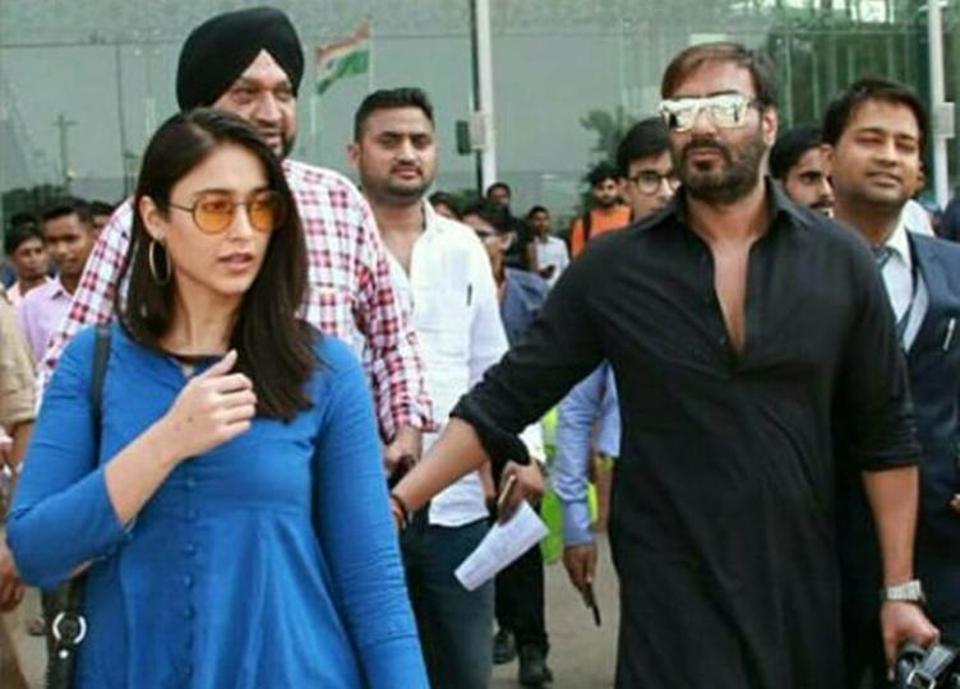
Stretched over two months Ajay Devgn and Illena D’Cruz shot Raid in the state capital a thriller which is based on raids that happened in 1980s. Produced by Kumar Mangat and directed by Raj Kumar Gupta, the film is set to hit screens in the first part of 2018. “Raid too is inspired by real incidents that took place in 1980s but are relevant even today,” Gupta told HT.

DaasDev

Sudhir Mishra’s DaasDev that was shot around two years back will finally hit screens on February 16. A spin-off of Devdas, the ensemble cast features Rahul Bhatt, Richa Chadda, Aditi Rao Hydari, Vineet Kumar Singh and Saurabh Shukla. The director dubs it as a reverse journey of Dass to Dev with lot of politics mingled in the love story making it very contemporary.


Mulk

Ra.One director shot his first film in the home state with Rishi Kapoor, Taapsee Pannu and Prateek Babbar. After making love stories, glossy and larger than life films he shot his first “realistic” since he started making films, confessed the director. He is ready with more projects. “I have a script ready which I was to shoot first but I will probably shoot next. It will be shot in a smaller place probably in a tehsil. I also have another film that again can be shot in Lucknow,” he said.

Vinod Bachchan’s next

The Tanu Weds Manu producer delivered another hit with Raj Kumar Rao-starrer Shaadi

Mein Zaroor Ana. Directed by Ratna Sinha, the film besides earning well was recently screened at Rashtrapati Bhawan. Bachchan is now working out to make another installment of the film. “We are working on the script and it will be either a sequel or its prequel. But, before that, we are coming to Lucknow to shoot two more films. Bin Phere Hum Tere and Yaaro Ki Baraat are two scripts that we will make making here this year. The cast is being worked out and we hope to start Bin Phere…first. It’s also a small town story from the Hindi heartland,” he tells HT City.

Ban in Pakistan

If we go by its name, the movie has already been banned in Pakistan! Titled Yeh Picture Pakistan Mein Ban Hai, the film was shot in Lucknow and is being made by Sunil Subramaniam. Starring Filmistan-fame Sharib Hashmi, Aditi Sharma, Chunkey Pandey, Upasana Singh, Mukesh Tiwari, Inaamulhaq, Nand Pakistani comedian Rauf Lala, the film was shot extensively in Lucknow for nearly 40 days. The film shot in 2016 is expected to hit screens soon.

Small films lined-up

“Besides big releases, the years will see films that have been shot in 2016 also hit screens. It is good that pending films will be realised like DaasDev and Yeh Picture Pakistan Mein Ban Hai. The message in Mumbai is positive and films are coming to the state. We hope the good run continues,” tells line producer Aroon Singh Dicky.

The movies that will also release soon are Aarzi starring Zeeshan Ayyub and Shama Sikandar. Then there is Tilli directed by Sagar Sharma with Raghuvir Yadav and Atul Srivastava. Lupt directed by Prabhu Raj with Karan Anand, Meenakshi Dixit, Vijay Raaz, Javed Jafri, Nikki Walia will also be shot soon.

Sharman’s two films

The shooting of the film Babloo Bachelor, directed by Agnidev Chatterjee was held at a house in Naka Hindola with actors Sharman Joshi, Aakash Dabhade and Puneet Vasishtha. The film’s story revolves around Babloo who’s looking for a suitable bride. The film also stars Pooja Chopra and Tejashree Pradhan. Earlier in 2017 he’s shot for the film Kashi in Varanasi. 3 Idiot famed actor plays character named Kaashi who is in search of his sister Ganga in the suspense thriller. Debutant Aishwarya Devan plays the female lead. The film has Govind Namdev, Akhilendra Mishra, Manoj Joshi, Manoj Pawha and Priyanka. The film is being directed by Dheeraj Kumar.

source: http://www.hindustantimes.com / Hindustan Times / Home> Cities> Lucknow / by Deep Saxena & S. Farah Rizvi, Hindustan Times, Lucknow / January 02nd, 2018

Entrepreneurs on the fast track

A mobile app and new-age rail ticketing

Anand Purohit earns IRs. 50,000 a month as a ticketing agent using the RailYatri app

Twenty-six-year-old Anand Purohit is not looking for a job any more. He says he has found a profitable vocation. This resident of the tiny town of Akot, in Maharashtra, was not keen on joining his father’s kirana shop and hotel business. “I wanted to break out on my own, earn for myself and do something different.”

Gunjeeta Tiwari Bhatt runs her business from home and can care for her baby too

Ditto the case with 31-year-old Gunjeeta Tiwari Bhatt, who had been working as an accountant for five years in Uttarakhand. When she married and moved to Delhi, she wanted to look after her child and also try her hand at entrepreneurship. “I manage to look after my one-year-old and run my independent business from home,” she says gleefully.

Both Purohit and Bhatt are part of a new breed of entrepreneurs created this year, thanks to the travel app RailYatrti. As ticketing agents for the app, authorised by the Railways, they earn ₹40,000-50,000 a month.

On any given day, the RailYatri mobile app has around 300 or so ticketing agents answering customers’ queries, helping them book tickets, confirm and re-book their journeys, and assisting with refunds on the massive Indian Railways network across the country.

All in one place

A third-party mobile app, RailYatri provides every kind of railway-related information, including train cancellations, route change, delayed start, important hotspots such as railway accident sites, visibility during fog and congestion on routes. But for services like ticket booking or queries on refunds, passengers are routed to the ticket agents via the app.

So, how does the app work? From the app installed on your mobile phone, you are routed to a ticket agent, who answers queries and handles the online booking. For those who find reservations tedious and complicated, the app is a convenient solution. It’s almost like how you book a cab on Uber or Ola. The difference here is that you have a human interface handling your travel requirements. Payments can be through money wallets, net banking, and debit and credit cards.

Besides handling all enquiries regarding train routes, distances, fares and refunds, the ticketing agent also suggests the best options for confirmed reservations. “We simplify train travel as much as possible,” says 42-year-old Deepak Suri from Bareilly. Known to be one of the most successful RailYatri entrepreneurs, he says he was about to close down his railway reservation agency when the mobile app appeared two years ago.

Today, he has eight employees to handle calls routed through the RailYatri app. With 100-200 phone calls for ticket bookings a day, he makes a monthly sale of ₹70-80 lakh. “Above all, the technology ensures that I get timely payment for my sales — no more do I have to work on credit.”

DEEPAK SURI, RailYatri agent in Bareilly

Sitting in Bareilly, Suri serves customers all over the country. “Requests come from Kolkata, Gorakhpur, Benares, Puri, Mumbai, Nashik — you name it.” The rail reservation business he set up 10 years ago had substantial traffic until it took a massive hit with the advent of cybercafés and online booking. Now he is back in profit with RailYatri.

Customer queries

And what is the most asked question by passengers? Purohit, who has employed two people this year, says ticket confirmations seem to be their main worry. “Through the app, which uses machine learning, I am able to give them the best solution.” RailYatri uses predictive analytics to zero in on wait-listed and quota-specific tickets with the best chance of confirmation.

“Refunds is another area where customers need help,” says Bhatt, who initially trained for a few days at the RailYatri headquarters in Noida.

RailYatri was started two years ago when technology buffs got together “to remove the black box that shrouds information regarding Indian Railways”. Today, the app has grown to include food and gift delivery at stations. And with its user base growing, the field is opening up for more Purohits and Bhatts to become part of the journey.

source: http://www.thehindubusinessline.com / Business Line / Home> India Interior / by Preeti Mehra / December 29th, 2017

200th Christmas for Faizabad church

A German music band celebrates Christmas with children

Faizabad

Built 200 years ago, Wesleyan Chapel, a fine specimen of British Architecture, for the British soldiers posted in Faizabad Cantonment, Church of North India is all decked up to celebrate Christmas.

Wesleyan Chapel, built in 1816, merged with Diocese of Lucknow in 1970 and then came to be known as Church of North India.

Talking to TOI, Rev Kaushalendra Solomon, pastor of the church said that special prayer service would be held at midnight on Christmas and then in the morning. Different religious activities will continue in the church till December 31and a special watch night service would be held on New Year eve.

The church committee led by secretary Chitij Charles has ensured special decoration with flowers and lighting as the Church has completed 200 years. Rev Solomon said that they get special cakes baked for Christmas celebrations at a local bakery.

“Ghulam Mohammad, a local scholar, said that Maulvi Ahmad Ullah Shah, who was leading the 1857 mutiny against Britishers from Faizabad, had instructed his soldiers not to damage the Wesleyan Chapel because it was a place of worship.”

source: http://www.timesofindia.indiatimes.com / The Times of India / Home> Neww> City News> Lucknow News / by Arshad Afzal Khan / TNN / December 25th, 2017

National film awards:The feeling is yet to sink in, says Yatindra

Lata: Sur Gatha is based on interviews with the legendary singer that took eight years to shape up.

Yatindra Mishra(HT Photo)

Yatindra Mishra, author of Lata: Sur Gatha, became the first UPite to win the Swarna Kamal award at the 64th National Film Awards that were announced on Friday.

After 12 years a Hindi work has won the Best Book on cinema category in the prestigious award. In 2005, Doordarshan’s ex-chairman Sharad Dutt from Delhi had won the award for his biography on KL Sehgal in Hindi.

Speaking to HT City from Ayodhya, Mishra said, “I still don’t believe that I have won the National Award for my book. It was only after I read it on official website and wishes started pouring in that I believed it to be true. Honestly, it is yet to sink in. It’s not just my feat but a glory for the state too.” The book gives an insight on melody queen Lata Mangeshkar’s life, her seven-decade career and its impact on Indian cinema.

The book has been selected out of 33 official entries in various languages. “Mostly books in Bengali, Marathi and other languages have bagged this award in previous years. The award carries a Swarna Kamal citation and Rs 75,000 each to the author and publisher – Vani Publication. The book, that was release in October last year, has already won three awards,” he said.

Lata Mangeshkar (HT File Photo)

Lata: Sur Gatha is based on interviews with the legendary singer that took eight years to shape up. “One year I just did the research while the interviews were spread across six years and then it took a year to pen the book,” he said.

In 2000, he wrote his first book ‘Girija’ on legendary classical singer Girija Devi followed by a book on shehnai maestro Ustad Bismillaha Khan, which is also a part of NCERT syllabus and is taught in schools. He has authored four poetry books and wrote a book on ‘Devpriya’ on dancer Sonal Man Singh.

“On cinema, I have written a musical history ‘Humsafar’ that came out during the celebrations of 100 years of cinema (2013). I also compiled Gulzar saheb’s poetry ‘Yar Julahe’ while another book is ‘Milon Se Din’ — a compilation of songs,” he tells. Mishra is now looking forward to speak to melody queen very soon. “Today I recall a line said by Lataji when I asked her about being conferred the highest civilian award Bharat Ratna. She said, ‘…shayad aapki apni bhakti aur vishwas bhi unmein sahayak hotey hai.’ (…probably your own devotion and faith helps in it).” He will be given the award by President Pranab Mukherjee on May 3.

source: http://www.hindustantimes.com / Hindustan Times / Home> Cities> Lucknow / by Deep Saxena,Lucknow, Hindustan Times / April 12th, 2017

From Varanasi to Canada

(L-R) Shivalika Agrawal, Neha Arora and Ritika Shani (BCCL/ Unmesh Pandey

Celebrating their foundation day in a rather hatt ke way, Urban Swag club organised a party with a Chalo Canada theme.

It was peekaboo in the life of Indians who live in that country through the eyes of Santa and Banta, enacted by Pooja Tandon and Shweta Chakravorty.

Even the anchors of the show was based on the character of Lalli and Preeto played by Neha Arora and Pari Beri, that added to the fun element. Their one liners led to loads of laughter. The humour was interspersed with some engaging dance performances.

Sangeeta Mehra, Rashmi Sahani, Alka Beri and Asha Dhawan danced to retro number Sainya Dil Mein Aana Re. Nancy Batra, Shama Sahani, Vanshika danced to Chak De Phatte while Shivalika, Neha Arora and Ritika Sahni danced to the pacy number Lean On. Pooja Madhok, Ekta Kapoor, Shweta Chakravorty, Sonia Bhasin, Pooja Tandon and Sakshi Kapoor danced to Tenu Suit Suit Karda.

source: http://www.timesofindia.indiatimes.com / The Times of India / Home> News> City News> Varanasi News / by Meera Vohra / TNN / December 30th, 2017

Kakori memorial to be tourist attraction

Lucknow :

The Kakori memorial has finally found a place on Lucknow tourism map. The memorial is set to become one of the must-visits for tourists with the state government developing it into a tourist destination.

A grant of Rs 2.5 crore has been sanctioned by the UP tourism department for the purpose recently. Granting additional funds, UP State Tourism Development Corporation chief AP Singh has fixed a deadline of July 2018 for the renovation so that the project can be dedicated to people in August, the month in which the Kakori train robbery took place.

Regional tourist officer, PK Singh said: “We have planned overall development of Kakori Smarak area as tourism destination.”

The plan includes setting up a library at Kakori Smarak with books dedicated to freedom struggle, particularly the Kakori train robbery, history and tourist places of Lucknow.

The auditorium will be used for screening 10-minute documentary films in English and Hindi on Kakori incident.

source: http://www.timesofindia.indiatimes.com / The Times of India / News> City News> Lucknow News / TNN / December 31st, 2017

The story of the Englishman who stayed back as a judge in India (and what it tells us about Nehru)

Having come to India in the service of an imperial power, William Broome died an Indian.

Justice William Broome is not a well-known figure today. But he lived an exciting and inspiring life.

He came to India as an imperial official, but defied British prejudices by marrying an Indian woman and devoting his life to India. He received Indian citizenship with the assistance of Prime Minister Jawaharlal Nehru and heard the early stages of Raj Narain’s challenge to Indira Gandhi’s 1971 election victory. He was unusual even among those British officials who stayed on in India after Independence. But his life still contains important lessons about what it can mean to be Indian.

William Broome was born in 1910 in London. He was appointed to the Indian Civil Service in 1932. He served in what was then the United Provinces (now Uttar Pradesh). In 1937, he married Swaroop Kumari Gour, the daughter of the lawyer, politician and academic Sir Hari Singh Gour.

This marriage was remarkable. Even though Broome served in the Indian Civil Service during a period of Indianisation, British rule in India was still characterised by racial hierarchies and segregation. The maintenance of colonial control involved the preservation of racial divides, aloofness and detachment from the Indian populace. Even India’s Anglo-Indian population was stigmatised and excluded by the English-born.

In marrying Gour, Broome defied these prejudices. He raised his children as Hindus (Broome was an atheist), learned numerous Indian languages and developed a strong interest in Indian culture.

Being Indian
Broome was appointed as a district and sessions judge in 1941. His independence in that role was legendary. When the chief secretary of the United Provinces declared that too many detainees under the Defence of India Rules were receiving bail, Broome responded by threatening the chief secretary with contempt of court.

Unlike most British judges and civil servants, Broome stayed in India as a judge after Independence. By 1958, Nehru was able to write of Broome that “I have seldom known any Englishman who has so Indianized himself in various ways as he has”, and that “he is as much as Indian as anybody can be who is not born in India and indeed probably more so than many people born in India”.

In that year, with Nehru’s assistance, Broome renounced his British citizenship and became an Indian citizen. He was appointed to the Allahabad High Court, where he served until his retirement in 1972. His judgments in this role demonstrated a strong concern for civil liberties, even going further than the Supreme Court of that time.

One of Broome’s final cases as a judge was to hear the early stages of Raj Narain’s challenge to Indira Gandhi’s 1971 election from Rae Bareli – the challenge that ultimately led to the Emergency. Broome had known Nehru and had once enjoyed a friendly relationship with Indira – he and his wife were even invited to Rajiv and Sonia Gandhi’s wedding reception. But he nonetheless made important procedural rulings in Narain’s favour. (Although Broome’s friendship with Indira Gandhi seems to have ended after this case, it is striking that no effort was made to delegitimise his decisions by referring to his foreign birth.)

Broome died in Bengaluru in 1988. Having come to India in the service of an imperial power, he died an Indian.

A noteworthy life
Broome was unusual. Although thousands of British citizens remained in India after Independence, few British officials or judges did so. Of those officials, Broome was one of the few who devoted himself to India not just as an administrator, judge or scholar but as a citizen. The fact that he embraced India until his death, and was embraced in turn, must be weighed against the departure of so many other British citizens, whether at Independence or upon their retirement, and the alienation of many Anglo-Indians from the new independent nation. His life was not necessarily representative of how other people of British descent in India felt or acted after Independence.

But Broome’s life is still noteworthy.

He was retained as a judge by the independent Indian government partially through pragmatism: despite the long struggle for independence, free India kept many of the institutions and officials that had governed (even subjugated) colonial India. But his life also reflected important, idealistic aspects of the new Indian state.

Broome came to India as an official of an occupying colonial power. He served as an official and a judge in a regime that imposed various rigid classifications: between races, between religions, between governors and governed. Broome rejected these classifications. After achieving Independence, the government of India did so too.

In the current age of escalating intolerance and xenophobic nationalism, Jawaharlal Nehru’s idea of India remains a powerful alternative to those who would make the nation great again by slicing away undesired pieces of it. Nehru refused, as Ramachandra Guha puts it, to “reduce India or ‘Indianness’ to a dominant religious or linguistic ethos”. Nehru himself described Indian unity as encompassing “the widest tolerance of belief and custom…every variety acknowledged and even encouraged”. Nehru’s idea of India was, as he put it, a nation of “enduring capacity to absorb other people and their cultural accomplishments”, drawing upon and enriched by ideas and faiths and traditions from around the world. Even though this vision failed to attract or keep many, even most, of the British people who had lived and worked in India under the colonial regime, it did allow Broome to be accepted as an Indian.

The fact that Broome was seemingly one of a kind demonstrates that this vision has not been completely honoured in practice. Broome was married to the daughter of a very distinguished Indian, held important offices and was seen to have “Indianized himself”. He may have been easier to accept as an Indian than someone without these characteristics, thus demonstrating limits to Indian tolerance.

There is hence a gulf between Nehru’s vision of India and how that dream has been fulfilled. But the vision is still important and still inspiring today.

Douglas McDonald-Norman is a researcher in Indian law, politics and history and a contributor to Law and Other Things.

For more information on William Broome, see Douglas’s article for the Indian Historical Review, “Becoming Indian: William Broome and Colonial Continuity in Post-Independence India”.

source: http://www.scroll.in / Scroll.in / Home> Magazine> History Revisited / by Douglas McDonald-Norman / December 26th, 2017

Allahabad University team finds cure to skin ailment, gets patent

Allahabad :

In a major breakthrough that would help experts find a treatment for ‘Pityriasis versicolor’, popularly known as ‘sehua’, a team of researchers from Allahabad University have developed a liquid medium for harvesting Malassezia fungus, which causes the disease.

The team is led by faculty member of AU’s botany department Anupam Dikshit. The team has also got the method patented (Indian Patent No. 290771) by the Technology, Information, Forecasting and Assessment Council (TIFAC) of the department of science and technology (DST).

Dikshit said, “Sehua is a skin disease which causes hypopigmentation of the skin resulting in the loss of its natural texture. The condition is accompanied by the occurrence of small white spots on face and other parts of the body.

“The disease is caused by fungus. The foremost challenge in developing an antidote was to first grow the fungus in a lab.”

Dikshit said that his team’s objective was to develop a medium suitable for the Indian environment and skin. He added that the medium available in the market was too costly and had other limitations as well. “The medium developed by us will be very useful for diagnosis of diseases and in finding a cure for the disease. Besides, the modified medium would also be of great help for various researches,” he added.

source: http://www.timesofindia.indiatimes.com / The Times of India / News> City News> Allahabad News / by Rajeev Mani / TNN / December 29th, 2017

Lucknow guava thriving in Arunanchal Pradesh

The local guava that starts fruiting here in two years has started yielding fruit in Arunachal Pradesh in only nine months, much to the amazement of the local administration, district horticulture officer and others.

“Commercial guava cultivation is new to this state and it is not a common crop for cultivation.” (HT Photo)

Believe it or not, the local guava that starts fruiting here in two years has started yielding fruit in Arunachal Pradesh in only nine months, much to the amazement of the local administration, district horticulture officer and others.

More than one lakh guava grafts of ICAR-CISH developed varieties reached Yachuli, 80 km away from Arunachal capital Itanagar, during the rainy season this year. Flowers and fruit could be seen on these plants this month, claimed Shailendra Rajan, director, Central Institute for Subtropical Horticulture.

Rajan credited this to the efforts made by progressive farmer Likha Maj by supporting tribal organizations Agro Gramin Limited (AGUN) and Green Gold, Naharlagun (Arunanchal Pradesh) in collaboration with ICAR-CISH, Lucknow for establishing guava industry in the north-eastern region for the benefit of farming communities comprising mostly of tribals.

Likha Maj took the initiative to transport grafts from Lucknow during the rainy season, when it was difficult to reach there by truck due to landslides and damaged slippery roads, he said.

A team of 10 youngsters took to planting and rearing these grafts in more than 100 hectares and made all efforts for their survival under highly difficult conditions.

“Commercial guava cultivation is new to this state and it is not a common crop for cultivation,” said Rajan.

After seeing such a huge plantation, about one hundred farmers were interested and started planting guava varieties transported from Lucknow.

“Maj has not only planted guava grafts but also motivated several farmers for starting its cultivation so that a sizable production takes place and the produce can be utilized for processing as a food park is in the process of approval,” director CISH said.

ICAR-Lalit, a variety developed from Lucknow, can play an important role in this area when the processing unit is ready, as it is a prime variety being used for making pink pulp from guava further used for different products as well as export.

Thousands of hectares under Lalit have come up in AP, Maharashtra and Karnataka and other states but for the first time this effort was made in the extreme North-East conditions.

The farmers regularly exchange views with scientists using plant photos taken in the field. Smartphone has played an important role in establishing linkage between the scientists from CISH-Lucknow and tribals in a remote area of Arunachal Pradesh.

CISH Lucknow has not only provided grafts but is also helping in establishment of a modern guava nursery in Arunanchal so that problems faced in graft transportation are eliminated and the good quality grafted material is available at a reasonable cost to be distributed to different parts of the north-eastern region.

source: http://www.hindustantimes.com / Hindustan Times / Home> Cities> Lucknow / by HT Correspondent, Hindustan Times,Lucknow / December 28th, 2017

Stoke Row’s Maharajah’s Well undergoes £25K revamp

Stoke Row’s Maharajah’s Well undergoes £25K revamp / ALAN MURRAY-RUST

A Victorian well that was funded by an Indian maharajah has undergone £25,000 refurbishment works.

Maharajah’s Well was gifted to the residents of Stoke Row, Henley on Thames, Oxfordshire, by the Maharajah of Benares in the mid-1800s.

He was moved by stories of water shortage in the area told to him by local landowner Edward Reade who worked in India for many years sinking wells.

Revamp work has included refurbishing the well’s gilded elephant statue.

The restoration of the 368ft-deep (112m) well – which began in April – also involved repainting the well and its canopy using Victorian methods, the Maharajah’s Well Trust charity, which has funded the work, said.

Chair of the trust, Catherine Hale, described it as a “unique structure”.

“It’s also an amazing story of this connection between a landowner in the Chilterns and a maharaja.”

Maharajah’s Well was officially opened on 24 May 1864 and cost £353.

source: http://www.bbc.om / BBC News / Home> News> England> Oxford / December 16th, 2017