A file picture of Lalji Singh, former Director of the Centre for Cellular and Molecular Biology, in Hyderabad. | Photo Credit: Nagara Gopal
Uttar Pradesh Chief Minister Yogi Adityanath condoled Lalji Singh’s death.
Eminent scientist and ‘father of DNA fingerprinting in India’ Lalji Singh died following a heart attack on Sunday. He was 70.
Dr. Singh was one of the leaders instrumental in making DNA fingerprinting mainstream in India, both at the level of research as well as for forensic applications.
This was after techniques advanced by him led to DNA profiling being used to establish parentage as well as solve some high profile crime cases in India.
Based on his work he was tasked by the government — in the late 1990s — to establish the Centre for DNA Fingerprinting and Diagnostics (CDFD) with a mandate of making it a nodal centre for DNA fingerprinting and diagnostics for all species and several diseases.
He also set up a slew of dedicated labs that worked on several aspects of genetics such as population biology, structural biology and transgenic research.
Dr. Singh served as a director at the Centre for Cellular and Molecular Biology (CCMB) in Hyderabad from 1998 to 2009.
He went on to become Vice Chancellor of the Banaras Hindu University (2001 – 2014), his alma mater.
Until recently, he was active in the Genome Foundation, a non-profit organisation that aims to diagnose and treat genetic disorders affecting the underprivileged, especially from rural India.
PTI adds…
“He complained of chest pain when he reached the Lal Bahadur Shastri Airport to board a flight for Delhi. He was taken to the Banaras Hindu University (BHU) Trauma Centre from there but he could not be saved,” O P Upadhyaya, chief medical superintendent of the Sunder Lal hospital in the BHU, said.
Singh, the 25th vice chancellor of the BHU, hailed from neighbouring Jaunpur district’s Kalvari village.
He was also an alumnus of the BHU and completed his BSc, MSc and PhD degrees from there.
Uttar Pradesh Chief Minister Yogi Adityanath condoled Singh’s death.
“Lalji Singh was the father of DNA fingerprinting. The country has lost a great educationist and scientist after his death,” he said.
Singh was also the recipient of the prestigious Padma Shri award.
source: http://www.thehindu.com / The Hindu / Home> Sci-Tech> Science / by Special Correspondent / Varanasi – Lucknow, (U.P.) / December 11th, 2017
Bharatiya Janata Party’s Sanyukta Bhatia was on Tuesday sworn in as the first woman Mayor of the Uttar Pradesh capital
Along with her, 110 newly elected corporators were also administered the oath of office in presence of a large number of their supporters, party workers, family members.
Soon after taking oath, Bhatia said that her top most priority was to improve the cleanliness rankings of the state capital and added that the corporation would seek all support and help from the state government to faster development of the city.
She also batted for more teeth to the civic body and the Mayor as well as implementation of the Constitution’s 74th Amendment. Bhatia also hinted that the municipal corporation would soon crack down on encroachments on roads.
Urban Development Minister Suresh Khanna as well as other senior colleagues like Rita Bahuguna Joshi, Ashutosh Tandon and Brajesh Pathak along with legislators of the ruling party were also present at the oath-taking ceremony.
–IANS
md/him/vd
source: http://www.business-standard.com / Business Standard / Home> News-IANS> Lucknow – December 12th, 2017
Anushka Sharma and Virat Kohli | Photo Credit: Instagram
While people can’t get enough of how stunning and much in love Anushka Sharma and Virat Kohli look in their wedding pictures, which are being circulated on social media, not many know the couple who made everything look so beautiful. Lucknow girl Devika Narain was entrusted with the task of designing the wedding and her husband, Joseph Radhik, was the one who clicked all those inspiring photos.
After the couple made their official pictures public on their social media accounts, Devika and Joseph, who had to keep all their work a secret from everyone, finally got a chance to reveal what had kept them busy for a few months.
“Some days, the whole world conspires to make things right. Thank you @virat.kohli and @anushkasharma, it has been an absolute honour and privilege to be a part of your journey,” posted Devika on her Instagram account.
She also wrote a post on her company’s Facebook account, “It’s finally all settling in, the cold is seeping back in and at this point I’m an odd mix of relief and immense excitement. We’ve been keeping a secret for a couple of months now and all of it has come to life today, in a beautiful tuscan village, where Virat Kohli and Anushka Sharma got married. We’re overwhelmed to have been chosen to be a part of such a special day. It means a lot to us to have had their trust, not just in keeping all of this a secret but to create a setting for their big day! Congratulations and thank you! #virushka.”
Devika made several trips to Italy’s Borgo Finocchieto to get every detail in place and make all the arrangements for a wedding that had the nation interested. Devika’s father told a national daily that she had kept her assignment a secret from her family as well.
After completing her schooling from Lucknow’s Loreto Convent Intermediate College, Devika studied English honours from Delhi’s Lady Shri Ram College. She worked at a popular wedding planning company for a few years before starting her own.
Devika has also designed the weddings of Indian cricketers such as Robin Venu Uthappa, Dinesh Karthik and more.
source: http://www.timesnownews.com / Times Now News / Home> Zoom> Entertainment / Times Now Digital / December 12th, 2017
Initiative to attract a large number of tourists from Nepal. The train will run on a 15 kilometer route and will carry eco-tourists through the forest area
Lucknow:
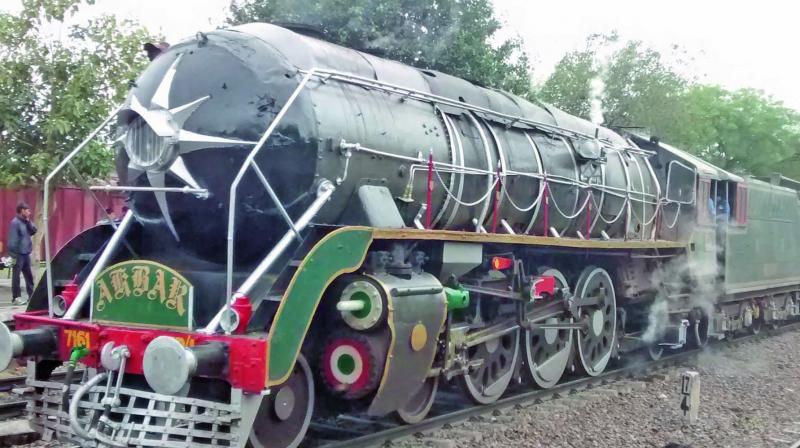
A vintage train that stopped moving for over 30 years now will start its journey once again.
The train will soon run through the thick foliage of the lush green Sal trees in Laxmipur range of Maharajganj forest division which is famous for the Sohagi Barwa Wildlife Sanctuary that has a huge population of antelopes besides rare and endangered birds and wildlife.
The train will run on a 15 kilometer route and will carry eco-tourists through the forest area.
The initiative for this was taken by UP chief minister Yogi Adityanath who wants to give a boost to tourism in eastern UP.
The railway authorities have already completed the survey of the track and found it fit for operations. The vegetation on the track, however, has to be cleared. Mr Manish Singh, divisional forest officer of the Sohagi Barwa Wildlife Sanctuary, said that while the train earlier used to run on steam engine, it will now be driven by a diesel engine between Laxmipur and Ikma. The forest official said that since the area is near Sonauli border with Nepal, it is sure to attract a large number of tourists from Nepal.
The track that runs along Taungya villages also has a parallel road alongside on which there is a heavy movement of people all day through.
The vintage train that used to run on a narrow gauge track had 56 bogies and four engines, apart from a saloon.
Incidentally, the train was started in 1922 to ferry wooden logs and its operations was stopped in 198
source: http://www.asianage.com / The Asian Age / Home> India> All India / December 10th, 2017
Kamlawati, widow of a coolie Pramod Kumar Gaud, received her badge on Wednesday
Varanasi :
The city before getting its woman mayor after the results of civic polls on Friday got the first . With her ‘Billa’ (badge) no-243′ Kamlawati, the mother of four, is mentally prepared to carry the luggage loads of passengers. Kamlawati, widow of a coolie Pramod Kumar Gaud, received her badge on Wednesday.
“As per policy guidelines of the Railway Board, the badge may be transferred to the family member, irrespective of the gender,” the chief area manager Ravi Prakash Chaturvedi told TOI.
“I am happy that the badge of my late husband was transferred to me. It will help me in rearing my children,” said Kamlawati (35), whose husband died in December 2016 owing to some ailment. She is ready to carry the loads of others to look after her three daughters and a son. Her eldest daughter Saloni (14) studies in class 8th, while Soumya (11) in 7th and Shrishti (10) in 5th class. The three-year-old Shresyansh is yet to begin his schooling. “I know the job of coolie needs physical strength as it is a difficult task for a woman like me, but I will do it for the sake of my children,” she said adding that she will join her duty when asked by the authorities.
Hailing from Deoria district Kamlawati lives with the family of her brother-in-law Sikandar Gaud, who is a constable in GRP, in a railway quarter of New Railway Colony near Cantonment station.
The coolie fraternity at the Cantt station is also haapy and ready to extend all support to her while on duty. “We tried to get the badge transferred to her so that she can earn living for her small kids. All of us will happily provide all support to her,” said the president of Varanasi unit of All India Coolie Union Kedar Yadav adding that she will be the first woman coolie in Northern Railway. According to him, a total of 194 coolies are there at Cantt railway station.
source: http://www.timesofindia.indiatimes.com / The Times of India / News> City News> Varanasi News / by Binay Singh / TNN / November 30th, 2017
The finishing line on the tracks of Madan Mohan Malviya stadium of the Sangam city witnessed history in making when three ace runners from the services finished back to back with a difference of few seconds, to bag the first three positions in the 33rd all India Indira Gandhi prize money marathon, held on Sunday.
Along with this Joyti Shankar Rao Gaute also wrote history by winning the marathon for the fifth time in a row and winning the prize money of Rs 2 lakhs.
In the men’s category, Yashpal Singh (chest number 323) of the services won the marathon by clocking 2:25:33 seconds. Wearing chest number 323, Yashpal, hailing from Kanpur, was applauded by the audience as the two of his competitors, one among whom was from Allahabad itself, were putting their best efforts to beat him. Yashpal bagged the prize money of Rs 2 lakhs by winning the marathon.
Close to Yashpal, Anil Kumar Singh (chest number 138), also from services and a native of Allahabad, bagged the second position staying just few seconds behind Yashpal. Anil clocked a timing of 2:25:39 seconds.
On the third position was Anand Singh (chest number 280) from Kanpur. The runner from services finished the marathon by a timing of 2:25:51 seconds.
In the women category, Joyti Shankar Rao Gaute (chest number 1162) made history by winning the title for the fifth time in a row. She had been the winner of this marathon since 2013. Gaute, a runner from Maharashtra, won the marathon by clocking a timing of 2:54:26 seconds, which was around four minutes more than her last year’s record when she completed the marathon in 2:50:57 seconds.
Gaute was followed by Anita Chaudhary (chest number 1200) of Gazipur who clocked a timing of 3:07:40 seconds to bag the first runner up of the marathon. The third place was won by Rani Yadav (chest number 1191) of Varanasi. She finished the marathon in 3:08:06 seconds, around one minute behind Anita.
Earlier the marathon was flagged off by ace Olympian and Laxman awardee Pramod Tiwari along with district magistrate, Suhas L Y and the International shuttler Abhhin Shayam Gupta who also distributed the prices of this 33rd all India Indira marathon.
source: http://www.timesofindia.indiatimes.com / The Times of India / News> City News> Allahabad News / TNN / Rajiv Mani / TNN / November 19th, 2017
A woman poses for a selfie during the heritage walk and (right) the poor state of the road leading to Kashishwar Mahadev temple
Lucknow :
A journey called ‘Yatra’ to lesser-known yet important landmarks of Lucknow on the city outskirts was organized on Sunday by INTACH (Indian National Trust for Art and Cultural Heritage.
The ‘Yatra’ started from Chatori Gali near Gomti Riverfront and had four stops, Kashishwar Mahadev Temple at Mohanlalganj, Shivala and Kakori Memorial at Kakori Road and Kudiya Ghat in Old City.
“The idea was to explore the monuments in Lucknow that are not much talked about. The tourism department doesn’t keep them in its itinerary despite their historical and architectural value. For instance, Kakori Memorial, it is one of the landmarks that tells so much about Lucknow’s association with the freedom struggle but it’s nowhere on the list of places to visit in Lucknow,” said Vipul Varshney, convener of INTACH’s Lucknow chapter.
She added, “Mostly when people speak about Lucknow, they talk of Imambada or Tunday Kebabi. Not even all Lucknowites know that these places exist. So, we want people to get acquainted with these monuments and give them their due importance.” The ‘Yatra’ was attended by 50 people, including 25 architecture students. Several among them visited these monuments for the first time.
“The most interesting stop of the trip was Kashishwar Mahadev Temple at Mohanlalganj. Built in 1860, it is a perfect example of Vastu Shastra. It has eight ‘Shivalayas’ and the top of the main compound has a ribbed dome on a rectangular base with inverted lotus finial and metallic pinnacle. It was fascinating to see anything so architecturally wonderful,” said Shweta Singh.
Expressing concern over the poor upkeep of monuments, Vipul said, “Despite their historical importance they are in shambles, be it Kashishwar Temple or Kakori Memorial. Despite getting lakhs of rupees for Kudiya Ghat’s beautification, river there is full of water hyacinth; even the stairs are not cleaned properly.”
“Kashishwar temple is ASI protected, but the approach is not cemented. Garbage was strewn everywhere,” said Aparna Mishra.
source: http://www.timesofindia.indiatimes.com / The Times of India / News> City News> Lucknow News / by Vidita Chandra / TNN / December 04th, 2017
‘Freedom’ in Varanasi ring: A day in the life of women’s wrestling at ‘benaras kesri’ The first woman ‘Benaras Kesri’ is national-level wrestler Freedom Yadav. (Express Photo by Anand Singh)
Vasundhara Yadav, 12, sporting a closely cut crop of hair and dressed in a red tracksuit, says she usually trains at the Sigra Stadium in the heart of Varanasi. But this is no ordinary Thursday for the 12-year-old, part of a group of young women wrestlers who’ve turned up at the five-centuries-old Tulsi Swaminath Akhara, Varanasi’s oldest mud wrestling gymnasium for men, at the Sankat Mochan temple on Tulsi Ghat.
It is dawn in the holy city, and there is palpable excitement among the group. The girls hope to pack in a practice session on the mud akhara before the main event of the day — the finals of the three-day Benaras Kesri, the city’s premier wrestling competition. For the first time in the event’s 30-year history, women, including girls as young as Vasundhra, are eligible to compete.
The Sankat Mochan temple trust, which holds the event, has this year split the Benaras Kesri title into two: one for men and the other for women.
At around 5 am, the practice session begins in earnest, with the girls silently folding hands in reverence to the wrestling deity, Hanuman, and the earth, the theatre of their sport, before stepping into the arena. Complex danv pech follows over the next two hours, amid instructions from the sidelines. At around 7 am, the girls pack up.
As she walks down the sloped cobbled lanes leading to the main road, Vasundhara says she began training six months ago after her parents agreed to let her pursue the sport professionally.
“Everyone is now inspired by movies like Dangal and Sultan. I too was inspired. I want to bring my country a medal,” she says. By 9 am, Vasundhara says, she will be at Assi Ghat, where the Benaras Kesri is to be held.
At the ghat, a large area has been cleared near the Ganga. Volunteers from akharas across the city have already laid out the yellow mat to wrestle on, plugged in and tested mics and arranged chairs, while former district and national-level wrestlers are set to double up as referees.
Varanasi’s wrestling fraternity had tested the waters for women’s wrestling last year, when they introduced a few friendly bouts between the girls at the competition. Favourable reception, shaped mostly by the Aamir Khan-starrer Dangal, emboldened the organisers to introduce a women’s championship this year.
“Women and girls have been wrestling in stadiums and even mud akharas in Varanasi for the past few years, but this is the first time they will fight at the open-air ghat before men who have never seen women wrestle. This will encourage women wrestlers of Varanasi and there will be many more grapplers next year,” says Prem Mishra, general secretary of the Uttar Pradesh Wrestling Association. The crowd places bets as the wrestlers take to the yellow mats. (Express Photo by Anand Singh)
As the finals kick off, spectators gather around, taking their places on the ghat steps or the ground. Bets are placed; money is handed out to the winners. Tea sellers make hay and tourists stop to watch. “What is happening here today?” asks Lea Neller, a young filmmaker from Berlin. She and her partner stay to watch the competition after being told that girls are wrestling professionally here for the first time. The crowd swells through the afternoon.
A group of women wrestlers from Bengaluru, including Pooja Yadav (18), who the organisers play up as “international player Pooja Yadav”, warm up as the men begin their bouts. There are a few surprised stares as the women unzip their jackets, take off their pants and stretch in wrestling singlets akin to that of the boys.
It’s these universal singlets, reckons Siya Ram, a 64-year-old coach at the Swaminath Akhara, that has eased the passage for women onto the mud, traditionally the sole preserve of male grapplers clad in the langot or loincloth. “Women were never allowed to set foot in the mitti ke akhare till as recently as 15 years ago, but now we realise what we have been doing to the girls is very wrong. They can also get our country medals; they are no less than boys,” says Siya Ram.
At the venue, there is further vindication for the organisers’ decision, with purists later marvelling at how well behaved the crowd was. There are hearty cheers with raucous bursts of advice each time a grappler is pinned down or locked in a stranglehold; a cut chin and blood elicits concerned hushed murmurs. “No one whistled or misbehaved. Every one was on their best behaviour though the audience was made up of locals from across the city,” says Vishwambhar Nath Mishra, the mahant of the Sankat Mochan temple, who is also a professor of electronics at the Benaras Hindu University (BHU).
The bouts involving women, particularly Pooja and Freedom Yadav (18), a national-level wrestler, draw less intense reactions, but even here, quick points and strong pin-downs extract howls of excitement and gasps from the crowd.
But women athletes sitting beside the veterans ringside have a grouse — “The men’s winner gets Rs 11,000 and a bike. For us, it is Rs 5,000 and a cycle,” one of them complains loudly. Kallu Pehalwan, the local pradhan and a former wrestling star of Varanasi, publicly admits it is a mistake. “Next time the prizes will be equal. Forgive us,” he gets the anchor to announce over the mic, to laughter in the audience.
Poonam Pal, an 11-year-old wrestler who crashed out of the competition the previous day, talks about how there were no weight-specific categories for the girls, unlike the boys. “It was not intentional. Actually, the decision to include women was taken at the last moment; only a few days ago. From next year onwards, the prizes will be the same and equal. And the competition will be conducted on a grand scale,” Prem Mishra now reassures.
Gopal Sahni, a local boatman who has been watching the wrestling for the last three decades, however, doesn’t agree. “The prize money cannot be equal and should not be equal because girls and boys are not equal,” he says. “Girls simply don’t have the same strength and fighting skills.”
As the day progresses, Vasundhra falls by the wayside, losing her bout. At around 3 pm, with the semi-finals for both the men and women having concluded, there is a sense of urgency. Who will the winners be? The men’s title is decided first, with Mukesh Yadav, a brawny young man, emerging the winner to take home the title of Benaras Kesri.
At 4.30 pm, it is the turn of the women. The title is to be decided between Freedom Yadav and Pooja Yadav. There is a hush as the bout begins. After six minutes of intense kushti, Freedom manages to pin down Pooja long enough to win the match. As the referee declares her winner, Varanasi gets it first woman Kesri.
Following a brief prize distribution ceremony, Mukesh Yadav proudly rides out with his prize — a blue motorcycle. Freedom, whose parents named her so because she was the youngest and “they wanted me to be free”, is thrilled at her bicycle. She mounts it as her fellow female wrestlers are arranged around her to pose for a group photo. Soon, the city’s ‘strongest woman’ is mobbed by the local media and spectators.
With the event done and dusted, mahant Vishwambhar Nath Mishra is a content man in his temple office. “I was apprehensive that I would be lampooned for making women fight in an open-air competition. There are so many people who could have voiced their opposition. But we must move with the times. Our culture is a living one. Only a dead culture does not adapt to the needs and wants of the society it serves and exists in,” he says.
source: http://www.indianexpress.com / The Indian Express / Home> India / by Sarah Hafeez / December 03rd, 2017
Buddhist monk Bhadant Galgedar Pragyanand, youngest among the seven priests who had initiated Babasaheb Bhim Rao Ambedkar into Buddhism in 1956, died here at Lucknow’s King George’s Medical University (KGMU) on Thursday morning.
Just about 18 days short of this 89th birthday, the Sri Lanka-born ascetic had been undergoing multiple age-related medical problems, including diabetes and high blood pressure.
Head of Lucknow’s Buddh Vihar near Risaldar Park in Lal Kuan area, monk Pragyanand had come to India at the age of 13 and was visited by Ambedkar in Lucknow twice, in 1948 and 1951.
Pragyanand was only 20 when Ambedkar first met him.
Disciples of the ‘gururji’ claimed that it was after his visits to Lucknow to seek blessings from Bhadant Boddhanant and Bhadant Pragyanand that Ambedkar was inspired to embrace Buddhism.
Bhadanta Pragyanand (File Photo)
Final rites in Shrawasti after procession in city.
A procession carrying the body of Bhadant Pragyanand in an open vehicle will leave Risaldar park situated Buddh Vihar at 9am. Following the Husainganj, Burlington, Odeon cinema route, the procession will reach Ambedkar Mahsabha where the body of its founder president will be kept for 15 minutes. The procession will then reach Hazratganj situated Ambedkar statue where a halt of 30 minutes will be made for tributes to be paid, when finally at 12 noon the body will be carried to Shrawasti for last rites as per Buddhist rituals.
‘Guruji spoke little but talking about Ambedkar would always energise him’
He was brought in on November 26 after complaints of fever and chest pain but had multiple age-related medical conditions,” said Prof SN Sankhwar, chief medical superintendent, KGMU.
Pragyanand was born on December 18, 1928, and had nephews and nieces in Sri Lanka who were in regular contact with monks in Lucknow, but could not come to India on Thursday. Followers and wellwishers of the old monk, including UP minister Swami Prasad Maurya, poured in at Buddh Vihar where his body was kept.
Bhikshu Pragya Saar, the oldest of Pragyanand’s disciple at Lucknow’s Buddh Vihar said, “When behenji (Mayawati) became CM for the first time in 1995, guruji asked her to go on a pilgrimage.
When she asked to which place should she make the pilgrimage to, he replied Shrawasti. And she indeed did.”He added, “It was also around 1997 that on guruji’s persuasion Behenji declared Shrawasti a district and raised its political importance to match its religious significance.”
Six disciples of the monk lived with him at the Buddh Vihar, one of whom Bhikshu Dharam Priya said, “I came under guruji’s wings in October 1999 and it was from him that I imbibed the unending energy and will to work. He had published 62 books on Buddhist teachings and had authored some of them.”
The disciples recalled, “Guruji spoke little but talking about Ambedkar would always energise him. He would tell us about the ceremony in Nagpur on October 14, 1956, where Babasaheb’s wife Savita Ambedkar was also present.” The group which had performed the ceremony was headed by Chandramani Mahasanghayak and had Bhikshu Paramshanti, Pannanand Mahathero, Bhadant Sadhatiss Mahathero, H Sangratn Mahasthavir and Bhikshu Sumedh.
source: http://www.timesofindia.indiatimes.com / The Times of India / News> City News> Lucknow News / by Yusra Husain / TNN / December 01st, 2017
Samsung India conducted the 7th edition of the annual Samsung Innovation Awards at the Indian Institute of Technology (IIT), Kanpur in association with Entrepreneurship Cell.
Samsung Innovation Awards aim to recognize and reward innovations that have the potential to revolutionize everyday living and enable students to take their ideas to the next level.
The first prize went to the team that included Kshitij Jaggi, Kumar Shivang and Rishabh Sahu who worked on a peer to peer financial transaction app using Blockchain technology in a distributed environment. The vision of the team is to enable financial inclusion of chit fund subscribers with Circle, a mobile ?rst solution for organisers to easily manage the members, bringing in transparency in the whole process and creating credit history for all Indians.
Insomniatec, comprising students Kaustubh Mundra and Sankalp Rastogi, won the second prize for proposing a project that uses an infra-red camera coupled with computer vision technology to detect drowsiness in a vehicle driver while in motion and provides in-time alerts.
One of the projects, Muskan Solid Waste, consisting Hari Shankar and co-founder Mewa Lal found a special mention at the awards. This is a start-up that converts organic waste into high yielding compost. The technique used reduces time for composting and produces more efficient manure compared to artificial fertilizers.
The awards were presented by Dr. Aloknath De, Chief Technology Officer, Samsung R&D Institute, India Bangalore (SRI-B). The winners were given cash prizes worth Rs. 2.5 lakh while the five finalists received merit recognition from Samsung.
Samsung Innovation Awards 2017 saw an overwhelming response, with eight teams getting an opportunity to present their ideas to the jury comprising Dr. Aloknath De from SRI-B and professors from IIT-Kanpur – Dr. Amitabha Bandyopadhyay from the Department of Biological Sciences & Bioengineering (BSBE), Prof. Sandeep Shukla from the Department of Computer Science and Engineering from IIT Kanpur.
Samsung R&D Institute Bangalore will engage with the award winners to further develop their innovations.
“Through the platform of Samsung Innovation Awards, we want to encourage students to work on innovative ideas in evolving areas of artificial intelligence, computer vision and IOT. When we see diverse and quality projects in these emerging technology areas, we can sense the pulse of our youth. Novelty of ideas, comprehensiveness in execution and impact of solution are yardsticks in selecting the winners. Samsung has been supporting deep-tech innovation at large and this year’s event in IIT-Kanpur is one such initiative,” said Dr. Aloknath De, Chief Technology Officer, Samsung R&D Institute, India – Bangalore.
Cutting-edge innovations were showcased at the competition. The innovative product ideas and solutions presented this year ranged from a cloud-based healthcare data management system to an intelligence platform for law enforcement and defence agencies.
“Innovation and entrepreneurship ought to become an integral part of institutions of academic and higher technical learnings. We must quickly transform into an innovation driven society where young minds understand societal needs, carve out opportunities and take calculated risks to become job creators and leaders. We are happy that corporates such as Samsung are coming forward to help us create the desired ecosystem at IIT Kanpur,” said Sameer Khandekar, Associate Dean, Innovation and Incubation, IIT Kanpur.
The 2017 edition of the Samsung Innovation Awards was initiated at IIT-Kanpur campus six months ago through an open entry process, where students submitted their innovative ideas. The shortlisting process was led by professors from IIT-Kanpur and researchers from SRI-B, who also selected the eight finalists.
The final teams presented their ideas to the jury at the IIT-Kanpur campus. The winning project was selected based on the degree of innovation, feasibility, usability, relevance and overall impact on masses.
Conceptualised in 2011, the Samsung Innovation Awards seek to support and encourage young talent who have an innovative approach and look to improvise different systems and processes. Further, it aims to develop indigenous products and services for fulfilling mass needs thereby transforming lives and creating sustainable solutions for the benefit of the society at large.
Over the years, Samsung Innovation Awards have become one of the most eagerly awaited ideation contests at IIT’s due to enthusiastic participation from the student community.
The first edition was conducted at IIT Delhi and since then Samsung Innovation Awards have been held at other major IITs. The last edition in 2016 was held at IIT Bombay and had witnessed great interest and enthusiasm from students. Samsung continues to provide the next generation of Indian innovators and entrepreneurs an avenue to showcase and advance their engineering skill sets. (ANI-NewsVoir)
source: http://www.aninews.in / ANI / Home / November 16th, 2017